Coffee Break · Uncategorized

Underground System

Edna St. Vincent Millay – Huntsman, What Quarry? 1939
Harper & Brothers, Publishers

Set the foot down with distrust upon the crust of the world — it is thin
Moles are at work beneath us; they have tunneled the sub-soil
With separate changers; which at an appointed knock
Could be as one, could intersect and interlock. We walk on the skin.
Of life. No toil.
Of rake or hoe, no lime, no phosphate, no rotation of crops, no irrigation of the land,
Will coax the limp and flattened grain to stand
On that bad day, or feed to strength the nibbled roots of our nation.

Ease has demoralized us, nearly so; we know
Nothing of the rigours of winter; the house has a roof against — the car a top against — the snow.
All will be well, we say; it is a habit, like the rising of the sun,
For our country to prosper; who can prevail against us? No one.
The house has a roof; but the boards of its floor are rotting, and hall upon hall
The moles have built their palace beneath us; we have not far to fall.

Coffee Break

Democracy Poem

Langston Hughes – From his One Way Ticket Collection – 1949s
Alfred A. Knopf (Publisher)

Democracy will not come
Today, this year
Nor ever
Through compromise and fear.

I have as much right 
As the other fellow has
To stand
On my two feet 
And own the land.

I tire so of hearing people say, 
Let things take their course.
Tomorrow is another day.
I do not need my freedom when I’m dead.
I cannot live on tomorrow’s bread.

Freedom
Is a strong seed
Planted
In a great need.

I live here, too.
I want freedom
Just as you.

Engaging Reads · Uncategorized

Pecan Pancakes with Maple Syrup Infused Prunes

Day 5/7 – Thursday, October 24, 2024

We’ve made it to day five and it doesn’t get any more simple than this! Just lovely. The maple syrup infused prunes were a touch of deliciousness. I made this recipe up, but you can tweak it as you see fit. Everyone has their favorite pancake recipe. Go with yours if you like and try the maple infused prunes along side and see how it all comes together. Go crazy!

Ingredients:

6 California Prunes
1/4 cup water
1 tablespoon of real maple syrup, plus more to top your cakes
1 cup of all-purpose flour
1 teaspoon baking powder
1 large egg
1/4 cup vegetable oil
3/4 cup buttermilk
1 tablespoon unsalted butter
1/4 cup pecans, plus more for topping

Heat a 1/4 cup of water on medium heat in a small saucepan. Once the water is boiling, add a tablespoon of maple syrup to the water and stir, making a simple syrup. Once the syrup has dissolved, add all six prunes and reduce the heat to low and cover.

Place one leveled cup of all-purpose flour to a medium sized bowl. Add a teaspoon of baking powder to the flour. Whisk lightly, just until mixed. Crack an egg into the flour and powder. Pour 1/4 cup vegetable oil and 3/4 cup buttermilk into the well made by the egg. Mix until batter holds few lumps. Add more buttermilk if batter is too thick for your liking. Pour in 1/4 cup chopped pecans and stir just until combined.

Allow batter to sit and rise for a few minutes.

Give a quick check to your prunes. You want to make sure they are not dissolving into a paste. We want them to remain in tact. If they look like they are breaking down, turn the heat off and remove the pan entirely.

Melt a knob of unsalted butter in a cast iron pan. Pour batter into the pan. If you follow the recipe as written above, batter will be thick and you will need to cook each side longer than you may initially think. Watch for air bubbles to pop on the uncooked side and be patient. Do not flip pancakes over until edges are golden and crispy and several bubbles and appeared. My cook time in total was 4 minutes on each side, as my pancakes were very large. Repeat for remaining pancakes.

Plate your pancakes.

Take a fork and gently remove each maple soaked prune, one by one and place them gently around your pancake. Pour desired amount of syrup on your cakes. Scattered chopped pecans on top. Pour yourself a cup of orange juice, coffee or tea and enjoy!

Note – You can use any sweetener you like to top your pancakes, but try to stick to real maple syrup for the simple syrup to infuse the prunes.

Further Note – A quick substitute for buttermilk when none is on hand. Add a teaspoon of distilled vinegar to a cup of milk. Let stand until bubbles/thicken presents itself.

Uncategorized

Understanding Narcissism – Buddy Willard

Chapter 8 of the Bell Jar starts out with a universal lament. As Esther is riding up with Mr. Willard (Buddy’s Dad) to visit Buddy at the sanatorium, she considers the Christmas season that just passed. This paragraph is a perfect example of Plath’s architectural gift as a writer.

“It was the day after Christmas and a gray sky bellied over us, fat with snow. I felt overstuffed and dull and disappointed, the way I always do the day after Christmas, as if whatever it was pine boughs and candles and silver and gilt-ribboned presents and the birch-log fires and the Christmas turkey and the carols at the piano promised never came to pass.

At Christmas I almost wished I was a Catholic.”

Can we not all relate to this feeling? The feeling of being let down during the holidays? Do we not all have a little bit of Charlie Brown in us? Searching for the meaning of Christmas. Hoping to be lit by its promised magic, and depressed when we either can’t find it or it doesn’t come. We could say Esther is incapable of finding the magic, since she is obviously very depressed, but this chapter is a flashback and we cannot be absolutely certain to know what state of mind Esther was in when she made her trip up the Adirondacks to visit Buddy.

As they drive further north into the mountains, Esther’s mood grows bleaker and bleaker. Another delicious phrase Plath writes on the first page of Chapter 8, “I don’t know what we talked about, but as the countryside, already deep under old falls of snow, turned us a bleaker shoulder, and as the fir trees crowded down from the gray hills to the road edge, so darkly green they looked black, I grew gloomier and gloomier.” As they draw closer, her sour mood increases, her dread at having to see Buddy building.

I found Plath’s description of the sanatorium’s color scheme as “liver” to be fantastic. Can’t you just picture it? Perhaps, liver was considered a soothing color back in the day? More likely, if this were real life, it would have been what was on sale in industrial quantities. Some writers might have chosen maroon, mahogany, or just plain brown to describe the walls and furnishings. Plath chose “liver” and it is one of the most humorous parts of this chapter.

After Mr. Willard left Esther and Buddy alone, (much to Esther’s dismay) Buddy brings up the subject of marriage. Esther tries to explain to Buddy she doesn’t want to get married, ever. She cites a former conversation they had about choosing to live in the country or the city, as her means to explain this to him. How she cannot be happy, as she wants two mutually exclusive things.

Esther’s inner dialog is a wheel of conflict. She wants to be seen as pure to the opposite sex, but desires sexual affection, as men of that age were able to do. She wants to go to college, to be a successful writer, to get the best scholarships and awards, to do something fulfilling with her life, that doesn’t involve the practicality skills such as shorthand. This goes against the norm of the day. The one that pushed women to become mothers and stay home to tend to their family and household, and forgo a profession. She wants to have the status of being Mrs. Buddy Willard, but does not want to be Mrs. Buddy Willard. Esther is a perfectionist who wants it all, even if “all” conflicts with itself.

The absurdity of the ski scene is striking. The fact that Buddy, a man who has never skied before, is insistent that he can teach Esther how to ski, merely because he has watched others do it so many times before, highlights just how cocky and narcissistic Buddy really is.

Here we find our protagonist, Esther, at the top of a mountain, being goaded by Buddy to ski down a slope, she was not comfortable traversing. Inexperienced skier Buddy pressured her to take the tow rope, up, higher and higher. He pressured her, knowing she was a perfectionist and would never say no. That she had to master everything that came her way.

So, when Esther took that fateful trip down the side of the hill and breaks her leg, in two places, we see the full face of Buddy Willard plain as day. Is he concerned for Esther? Does he offer an apology or even acknowledge his role in the tragic event? No. He smiles. Not an awkward apologetic smile, but a “queer, satisfied expression” came over his face. Even if that expression came about as a nervous reaction, he doesn’t retract, withdraw or make his expression blank, knowing he is displaying an inappropriate expression, but he gives a “final smile”.

What a jerk. I wouldn’t want to marry Buddy Willard either. No matter how good looking or how much money he had, he is a conceited ass. How could one live with someone like that? Someone that makes an ashtray for his supposed love, a love who doesn’t smoke. Someone who plays on that same loved one’s insecurities. Her insecurity being that she is a perfectionist. He knows she’ll take any bait he dangles in front of her. He is a classic narcissist, always needing to be right, to be in control and to put those whom he “loves” down to lift himself up.

Esther is better off without Buddy Willard.

Uncategorized

Nobility Plate Silver (Royal Rose) – VOWS NOT NECESSARY

Vintage Advertisement of the Week – September 26, 2024

Seventeen Magazine – June 1950

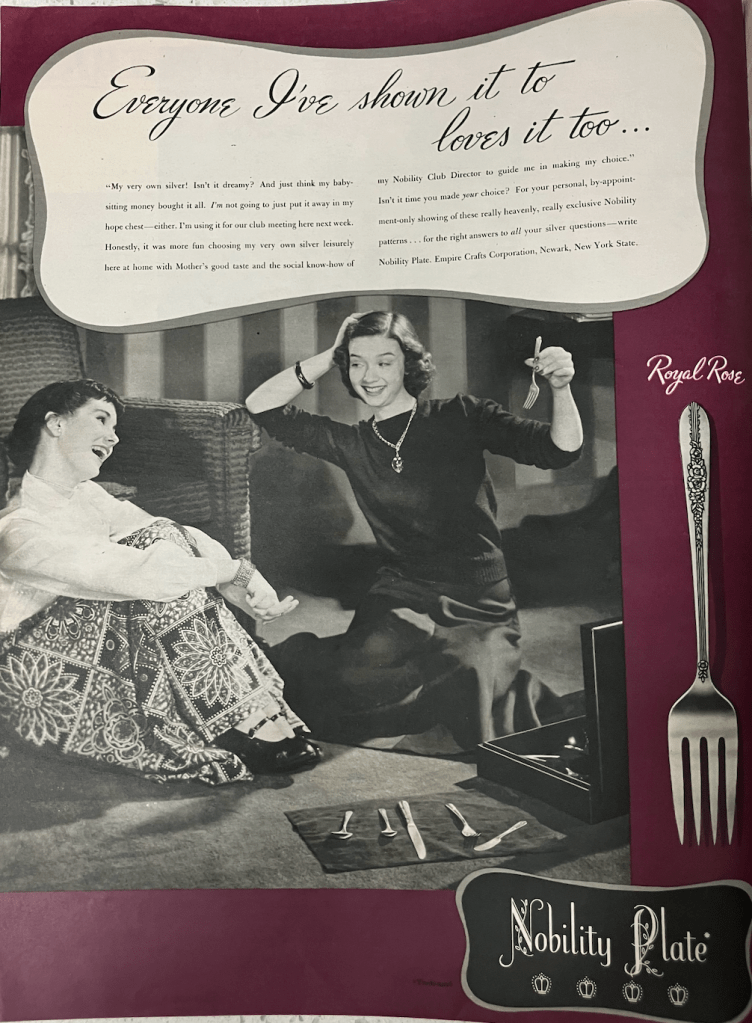
My gosh, what can I say about this ad? I love it! Not only for the retro aspects (hairstyles, clothes, wallpaper), but also for the things it leaves out. Not a single mention or allusion to marriage. The few popular magazines geared toward teenaged girls during the 1940s and 1950s often contained what we might, by today’s standards, consider to be strange ads. It was common to see full page spreads taken out from silver, cedar chest, china (dishes), and carpet companies. If there was talk about silver sets, it usually meant one thing, engagement, but not this ad. There is no mention of upcoming bliss, let alone a guy.

For fun, let’s compare the words of the 1950 Seventeen magazine advertisement and another silver set ad from the late 1940s. Here’s the text in a more readable photo:

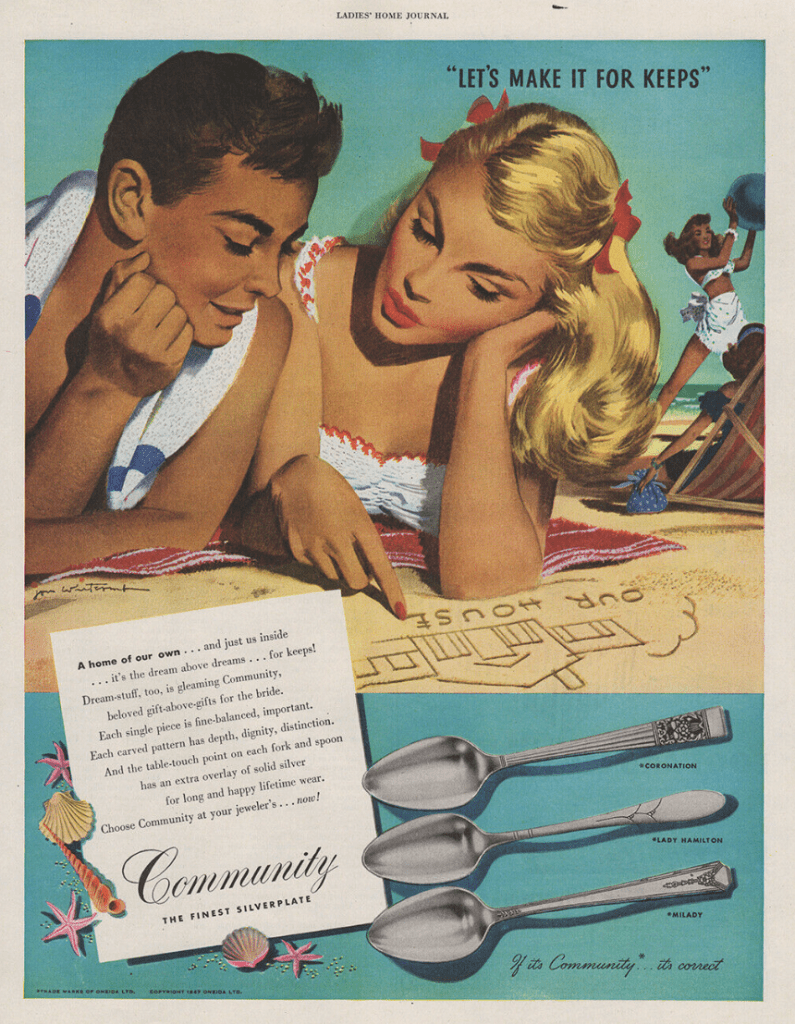
In contrast, this ad from a 1947 Ladies Home Journal hits the marriage theme right between the eyes:

The Nobility Plate ad starts off by the owner of the silver bragging to her girlfriend. She says she bought the silver with her very own money she earned babysitting. She had help picking it out, but not from her fiancé or steady fella. Rather, she used advice from her mother and the Nobility Club Director to inform her decision. She plans on using it for the next club meeting the girls are having and is going to store it in her personal hope chest when not in use. No mention of a steady beau or betrothed in sight.

On the other hand, the Community Silver (Oneida) advertisement mentions a bride right off the bat. The advertisement hits us over the head with the girl pointing to a picture of their dream house she drew in the sand with her fingernail. This ad uses words like, “depth”, “dignity”, “distinction” and “lifetime wear”. Making the reader feel the couple has a long lasting chance at a happy life shared together if they purchase the pictured Community silver set.

Our Nobility Plate ad uses adjectives and phrases such as “dreamy”, “choosing my very own silver”, “good taste”, “making my choice” and “personal appointment”.

The girl holding the silver in the Nobility ad is showing it off to her girlfriend, while the girl in the Community ad is talking about future plans with her obviously betrothed male companion.

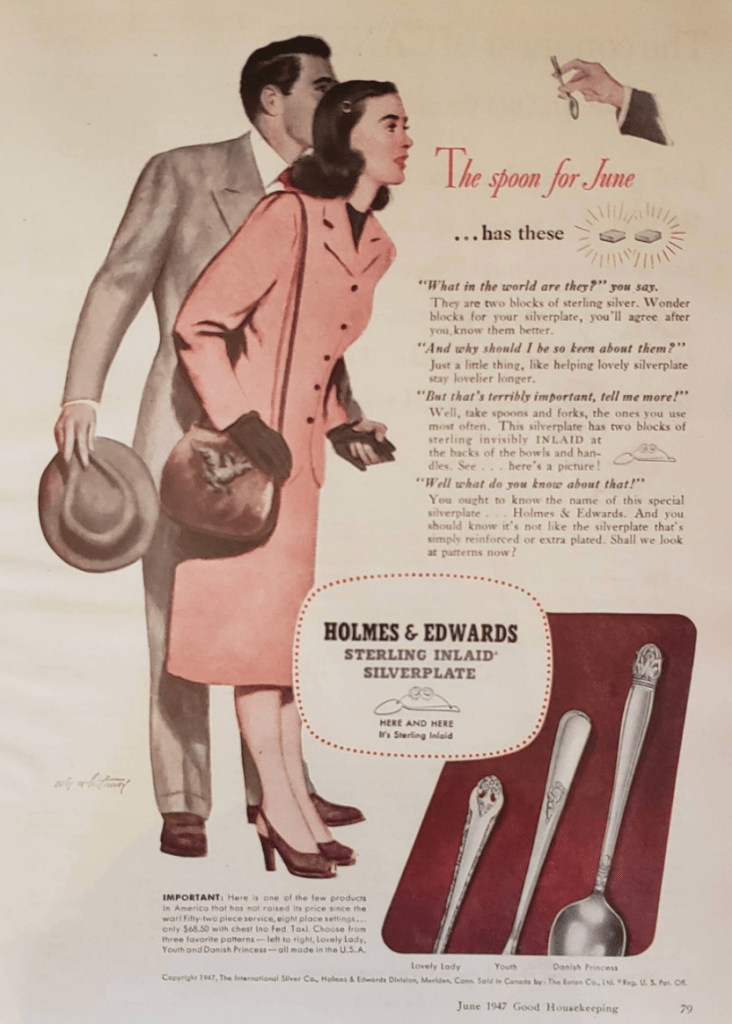
Most silver set ads of this era either showed a newlywed couple, a married couple or just the silver, laid out beautifully on a table set for entertaining. It is actually very difficult to find an ad for silver from the 1940s to the 1960s that doesn’t cover one of those angles. A few more examples illustrating these common themes are:

June 1947 Good Housekeeping – Holmes and Edwards (June, the traditional month marriages took place back the 1940s, 1950s and 1960s.)

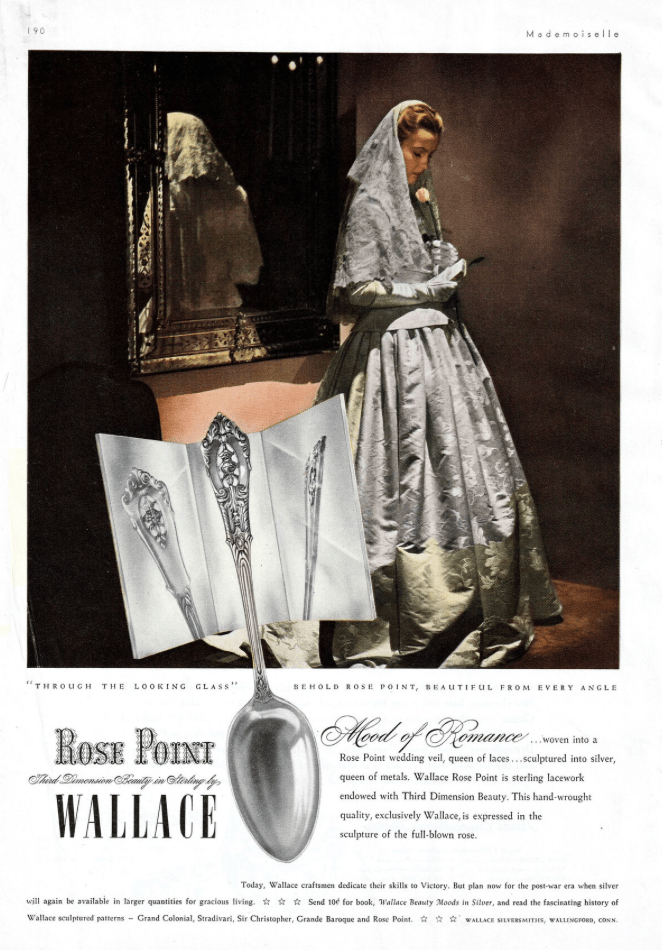
1945 Mademoiselle Magazine – Rose Point Pattern by Wallace (“Mood of Romance”)

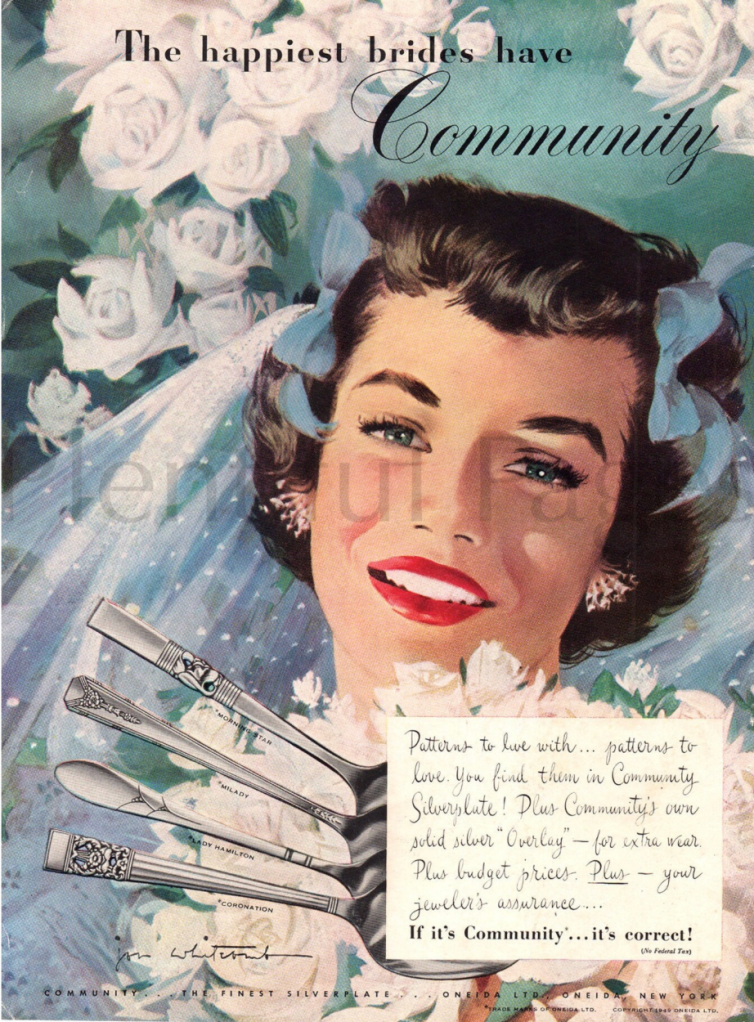
Another Community Silver Ad Oneida Limited circa 1949/1950.

Brides, brides and more brides. Silver set companies like Oneida and Wallace built their empires around marriage. It makes sense. Most people didn’t have a need for a silver set unless they were getting married and needing to fill a new house. But, that’s what’s so novel about Nobility Plate. To put their eggs into a different basket. The basket of the young girl with a dream that did not center around a man, getting married, starting a family and entertaining to their married friends. Nobility Plate pitched their message to those girls that wanted to do their own thing. Ride their own wave. Not because owning a silver set was a necessity even, but because, gosh darn it, she could have it. And, she could have it with the money she earned herself.

Don’t get me wrong, I’m not anti-marriage. If that’s your dream, go for it. Plenty of people are and there’s nothing wrong with it. So go ahead, get married, pick out the perfect silver set for you and yours. Yet, if it makes you happy to buy the silver while you are single to show off to your chums, sorority sisters, or what have you, I say go for it. Treat yourself, you deserve it. After all, you earned it. That goes for all the single guys out there, too. Buy the silver, show it off, be proud of it. It’s your life and your dreams.

Uncategorized · Vintage Ads

Families Who Care Use, Fruit of the Loom

Vintage Advertisement of the Week – September 12, 2024

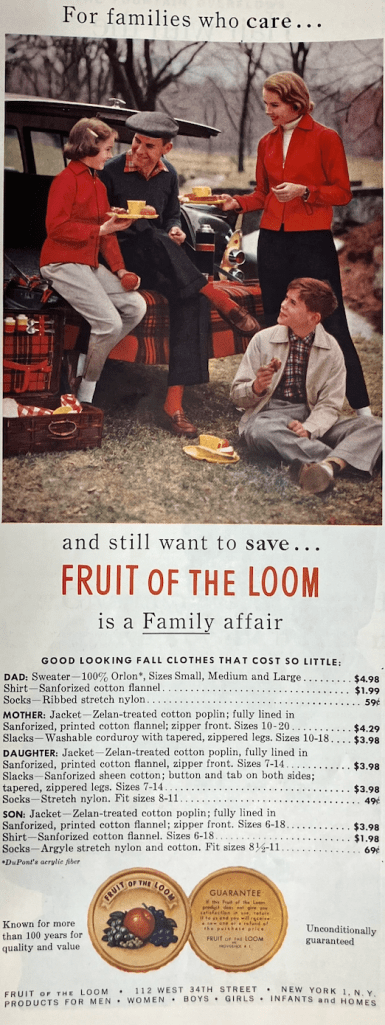
Vintage Advertisement taken from the Ladies Home Journal – October 1956.

It all started in Warwick, Rhode Island, back in 1851. Two brothers named Robert and Benjamin Knight purchased a mill and started spinning cotton into cloth to make undergarments and affordable clothing.1 Thus, cotton became the fruit of the loom.

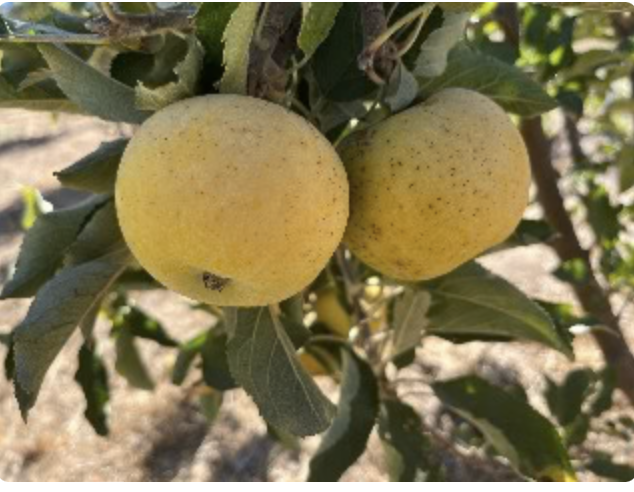
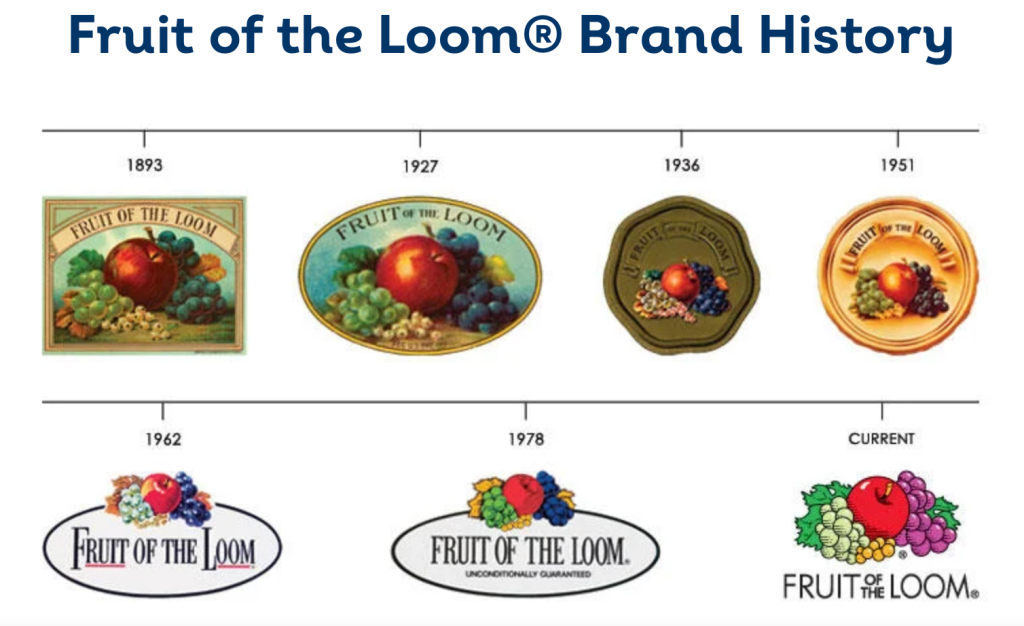
The iconic brand’s trademark, fruit piled up aplenty, was designed in stages and over the years. (Note, when we think of Fruit of the Loom, our brains automatically insert a cornucopia. The truth is there is no evidence Fruit of the Loom ever used a cornucopia as their trademark. Just like the Monopoly Man never wore a monocle. it’s our brains getting confused with Mr. Peanut. In the case of Fruit of the Loom, it could be our brains getting confused with a Thanksgiving centerpiece. I digress…) The origin story lands squarely on the shoulders of Rufus Skeel’s daughter, Jessica Skeel. Rufus was a cloth merchant from Providence, RI. While visiting the factory with her dad, Jessica painted fruit on bolts of muslin clothes the company was to use. The marketing department found out the products that had her painted fruits on them sold more than the plain items. Jessica started out by painted a swaar apple, a fruit her family enjoyed.2

Swaar Apple Photo3

The Fruit of the Loom logo has changed over the last century. But fruit has always been its focal point.

The goal of Fruit of the Loom during the mid-20th century onwards was to sell high quality, affordable undergarments. The biggest innovation for the underwear industry, besides affordable pricing and high quality, was the 3-pack. They began selling men’s boxer briefs in 3-packs in the 1940s. They were also the first underwear manufacturer to advertise on television in the 1950s.

Fast forward to the 1980s. Anybody else remember the Fruit of the Loom Guys? They were eerily similar to the Kool-Aid Man. Check out this cheesy commercial featuring them in 1987, complete with David Allen Grier no less! I’m trying to figure out what the guy in the brown is supposed to be. A raisin? A date? A pineapple? If you know, please put me wise.

There are so many highlights to a company that has been around for over a century and is still going strong. From their partnership with sports leagues and clothing manufacturers (baseball and basketball) to their helping make parachutes for the Allied Troops in WWII, to providing for the everyday American, they really made their mark on the clothing industry. Check out a fun timeline just some of Fruit of the Loom’s highlights over the years here.

Back to the vintage ad at the very top. The guys look like they are straight out of Leave to Beaver or Father Knows Best. Even going causal back then was keen. Everyone looks so crisp and put together.

I am honestly salivating over the simple elegance of the outfits the mother and daughter have on. It looks like they are ready to go camping in very comfy, yet spiffy clothes. Where oh where can I get some Fruit of the Loom corduroys for $3.98 and a snazzy red zip up jacket like that for only $4.29. When I do the math, it’s not as cheap as it sounds. That would be $46.06 and $49.56 respectively. Yet, for high quality, comfortable, nifty clothes, I would pay it. Maybe it’s not outlet prices, but it’s not too far off the mark.

The ad at the top really hits home to the driving force of apparel purchasing power in the 1940’s, 1950’s and onward. It is speaking directly to the matriarch of the family. Advising her to buy Fruit of the Loom for her entire family. If she does it shows she cares. It also shows those around her family that they have good, yet sensible taste. What else would you expect from a century old company founded in the heart of New England? Sensible, practical, quality made goods.

Look good and loom large with Fruit of the Loom.

  1. “Fruit Story – Static.” Www.fruit.com, http://www.fruit.com/fruit-story-static.html.
    ↩︎
  2. “History – Fruit of the Loom, Inc.” Fruit of the Loom, Inc., 2019, http://www.fotlinc.com/our-company/history/. Accessed 11 Sept. 2024.
    ↩︎
  3. Swaar Apple Tree. “Swaar Apple Tree.” Trees of Antiquity, 2019, http://www.treesofantiquity.com/products/swaar-apple-tree?srsltid=AfmBOoplFpQlsrwIPnfPYpXdd1muOI2j0iMk8bJXEGPiMslRp6csvZH2. Accessed 12 Sept. 2024.
    ↩︎