
Vintage Advertisement of the Week – September 19, 2024
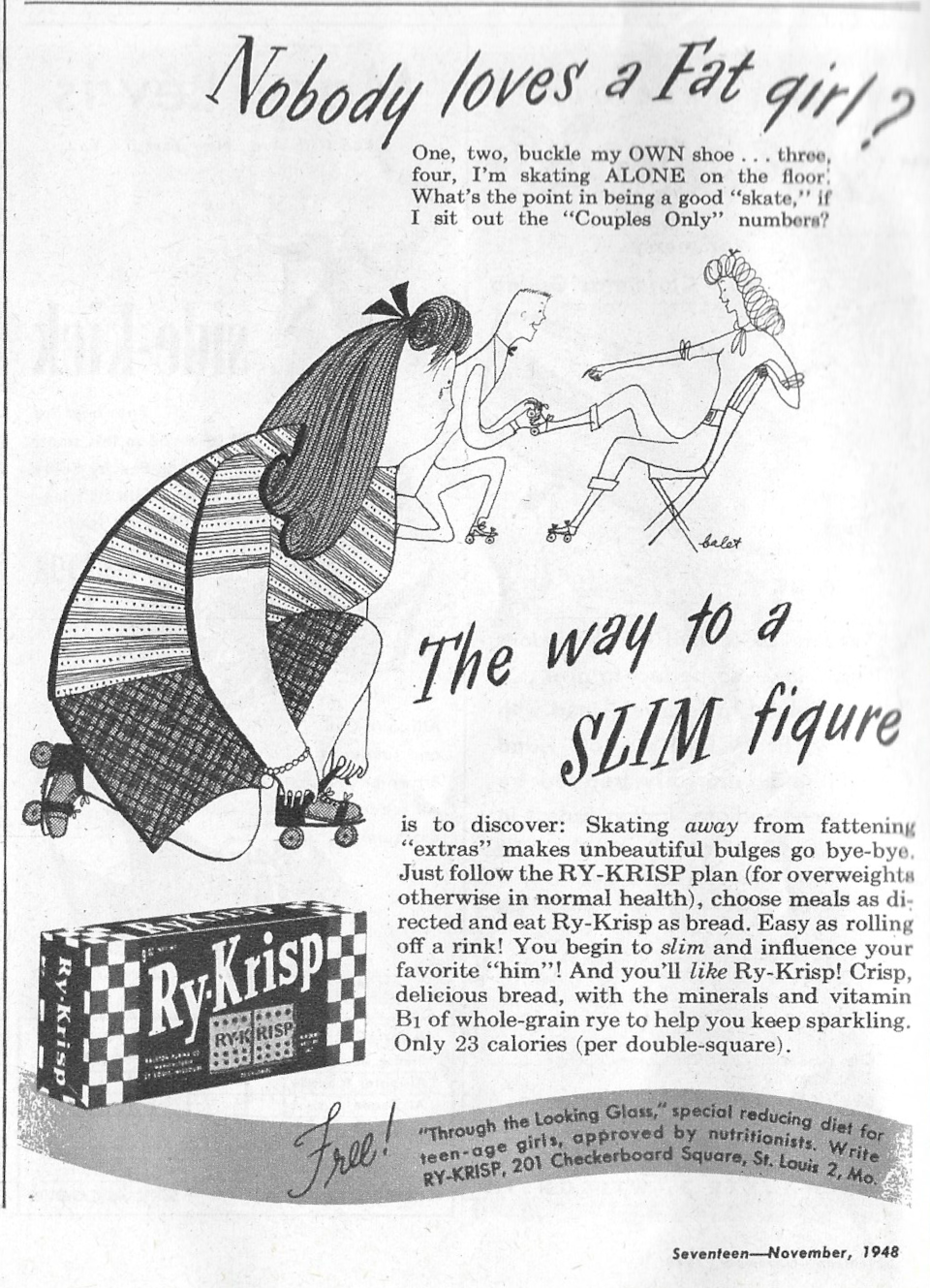
Seventeen Magazine – November 1948
Talk about traumatic! Marketing executives of the 1940’s were keen on throwing shade anywhere and everywhere they could get it to land and this ad has a whole lot of shade.
Have you ever eaten rye crackers? They are rather bland. In the world of manufactured snacks, they are at best forgettable and only as good as what you dressed them up with. It’s reminiscent of the 1980’s rice cake diet fad. Anybody remember that? I digress. If I had to guess, I would say they were so successful for two reasons; 1) Scandinavian Americans adored the crackers, and 2) Ry-Krisp’s diet campaign.
A Brief History of Ry-Krisp
Ry-Krisp was founded by Arvid and Erik Peterson, brothers who immigrated to the United States from Sweden in the 1800’s. They brought with them a recipe for knackerbrod. Knackerbrod was a 19th century Scandinavian staple. It was made twice a year, had no yeast and kept an incredibly long shelf life. Best known as being a digestive biscuit, it was baked with a hole in the middle so it could be stored on a long rod for the best drying practices.1
The Peterson brothers settled in Minneapolis, Minnesota, a veritable hub for Scandinavian immigration during the mid to late 1800’s.2 A few key historical highlights of the company:
1904
Peterson Brothers open up a bakery on Lyndale Avenue, Minneapolis, MN.
1913
The Peterson Brothers sell to a local investment group, changing the name of the company to Ry-Krisp.
1926
Ralston Purina (of dog food fame) buys out Ry-Krisp and markets it as a health food. 3
2013
Conagra acquires Ry-Krisp, shutters factory in Minneapolis two year later and production of the cracker ceases.
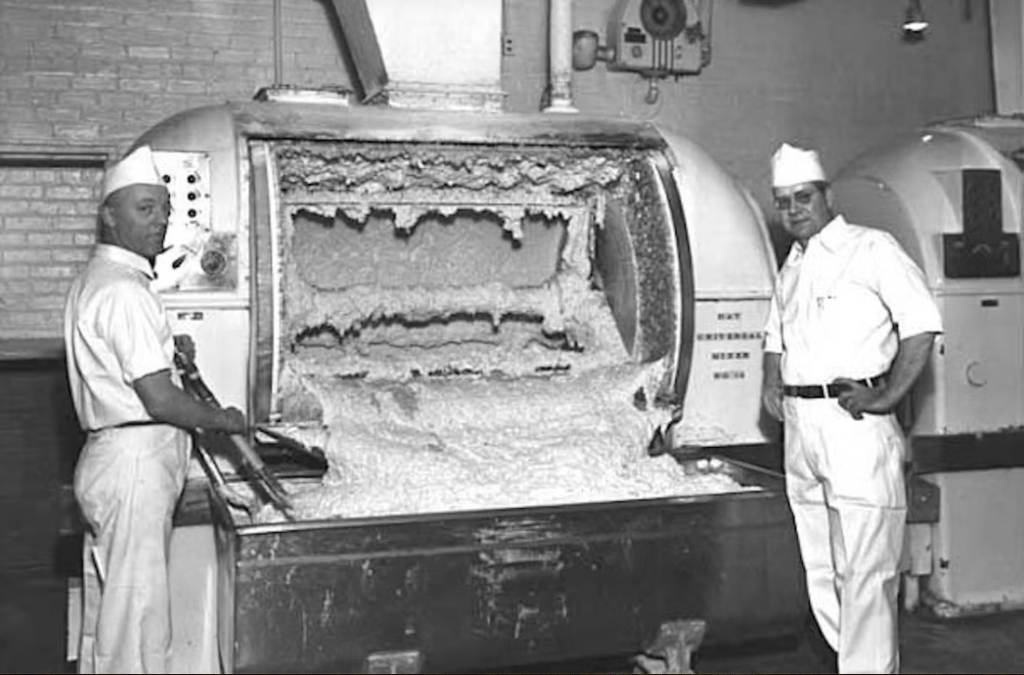
The Petersons and their vision for a marketable rye cracker fit right in with Minneapolis of the late 1800’s. Minnesota, especially Minneapolis, was a center of flour mill activity. It was home to Gold Medal Flour/General Mills4, Pillsbury Flour5, and Malt O Meal (Northfield, MN, n/k/a Post Consumer Brands)6. It was big business back in the day and still is. Here is a photograph from 1949 taken of one of the machines that helped make the Ry-Krisp cracker.7 I wonder how the paste made it from this machine to cracker form. It’s too bad footage of the entire process doesn’t exist.
Premade or convenience foods helped liberate the modern woman of the late 1940’s and 1950’s.8 The rye cracker also grew in popularity throughout the United States (rye being a staple grain in not just Norway, Sweden, and Denmark, but much of Northern and Eastern Europe). I can see why Ry-Krisp lasted for over a century.
Due to its long shelf life and convenience, Ry-Krisp really got around. Salad with Ry-Krisp while you travel down the tracks in luxury?

A fun look at a recreation of a menu based off the old Pennsylvania Railroad menus. Check out the luncheon offerings. The New York Public Library Archives have some other fun glimpses into past
The Untapped Teen Market
Convenience aside, the teen market executives hung their shingle solely on two words, “loneliness” and “diet”. Magazines like Seventeen and Calling All Girls are littered with ads that preyed on a young girl’s doubts toward her body size and being ostracized because of it.
Here are some other examples of how marketing sharks sunk their blood thirsty teeth into a young girl’s confidence:
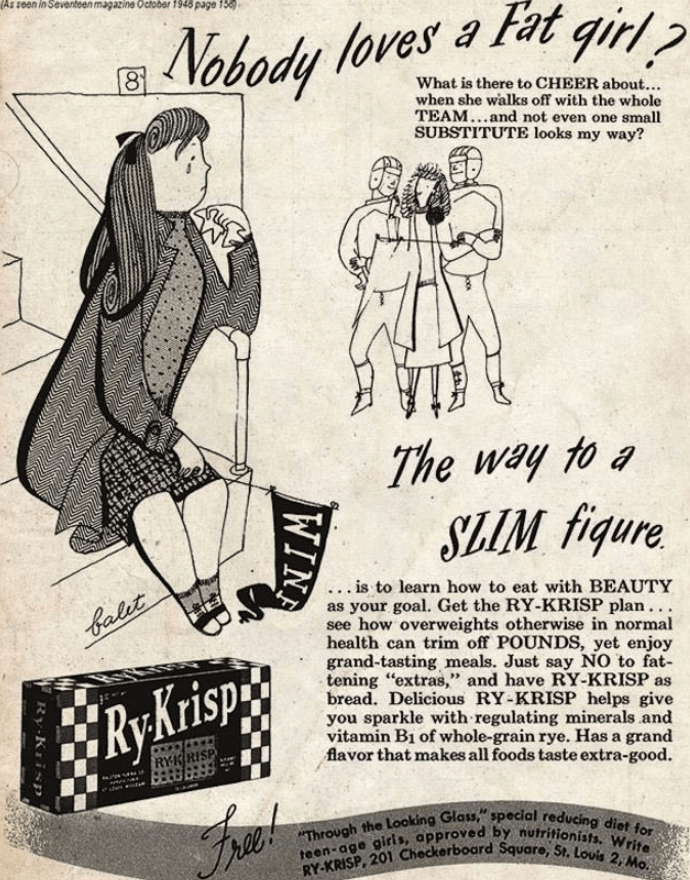
Ry-Krisp Ad, Widely Circulated 1948

Calling All Girls – July 1947
Through the Looking Glass
I’ve got a 1945 copy of “Through the Looking Glass” a 1,500 calorie diet for teenage girls coming in the mail. I’ll share tidbits in the coming months. The advertisement from which I purchased the pamphlet says it calls for a 1,500 calorie limit for 16 year old girls who want to lose weight the Ry-Krisp way. While it might be doable, suggesting a diet to a person, teenager or not, should be up to the medical professionals, not the Mad Men of the snack world. It’s a dangerous line to walk, but advertisers do it all the time.
The common themes in all of the teenage Ry-Krisp ads above are cruel and insidious. Flat out telling a young girl she will be alone because she is “overweight” and needs to reduce her body by eating their product is nothing new, but it is the way they are so in the reader’s face about it. Marketing these days is bad enough, but I’m not sure I’ve seen ads from the 2020’s as bad as these Ry-Krisp ones.
Back to the question above. Can a fat girl find love? I think we all know the answer to that. Yes, yes, they can, with or without the help of rye crackers.
***************
- Kaeding, Mary. “Ry-Krisp Company | Kraus-Anderson History Corner.” Kraus-Anderson, 22 Nov. 2019, http://www.krausanderson.com/blog/ry-krisp-co-kraus-anderson-history-corner/.
↩︎ - “Swedish Immigration to Minnesota | MNopedia.” Mnopedia.org, 2019, http://www.mnopedia.org/swedish-immigration-minnesota.
↩︎ - “Ry-Krisp | MNopedia.” Mnopedia.org, 2024, http://www.mnopedia.org/thing/ry-krisp. Accessed 19 Sept. 2024.
↩︎ - “Gold Medal – Brands – Food We Make – General Mills.” Www.generalmills.com, http://www.generalmills.com/food-we-make/brands/gold-medal.
↩︎ - Association, Marcy-Holmes Neighborhood. “Pillsbury “A” Mill (1881).” Minneapolis Historical, http://www.minneapolishistorical.org/items/show/98.
↩︎ - Hess, Stephanie. “For Almost a Century, Malt-O-Meal Has Been Made in Northfield.” MinnPost, MinnPost, 9 Sept. 2019, http://www.minnpost.com/mnopedia/2019/09/for-almost-a-century-malt-o-meal-has-been-made-in-northfield/. Accessed 19 Sept. 2024.
↩︎ - BURGER, KEVYN, and KEVYN BURGER. “That’s How the Cracker Crumbles: Remembering Ry-Krisp as It Ends.” Startribune.com, 19 Mar. 2015, http://www.startribune.com/that-s-how-the-cracker-crumbles-remembering-ry-krisp-as-it-ends/296763801. Accessed 19 Sept. 2024.
↩︎ - National Women’s History Museum. “How Highly Processed Foods Liberated 1950s Housewives.” National Women’s History Museum, 11 May 2017, http://www.womenshistory.org/articles/how-highly-processed-foods-liberated-1950s-housewives.
↩︎
 Tidbits and Timemachines