Uncategorized

Ptomaine Poisoning and Buddy Willard

While reading The Bell Jar this time, I wondered, did Plath write about her food poisoning incident and follow it up with our in depth introduction to Buddy Willard with intention? Without a doubt, the guest editors’ bouts with ptomaine poisoning leaves an impression and makes the reader think twice about wanting to eat crabmeat and mayonnaise anytime soon. Plath wrote the scene so vividly, you can practically hear the retching in your head and smell the vileness that must have permeated the halls and bathrooms of the hotel/apartment from the women that fell ill.

I found it interesting it took what must have felt like a near death experience for Esther to realize she wasn’t going to hang out with Betsy’s crowd. That, deep down, she really was drawn to Doreen and needed Doreen’s influence in her life. Esther is an interesting character. Very much like Plath, relatable, yet not always the nicest person. Which brings us to her portrayal of Buddy Willard.

Poor Buddy Willard. I say “poor Buddy Willard” a little tongue in cheek. Plath writes Willard as if she has a major axe to grind. He is a pompous person. Any female can appreciate the scene where Mrs. Tomolillo is giving birth. She is obviously in tremendous pain, but Buddy assures Esther the birthing woman is in a “twilight sleep” from the drug they gave her. Esther knows that’s a load of bull, pointing out Mrs. Tomolillio wouldn’t be groaning if she weren’t in pain. We’ve all known someone like Buddy. The type of person who offers their self-proclaimed expert opinion, even when not asked. A person you just can’t help wanting to knock down a peg.

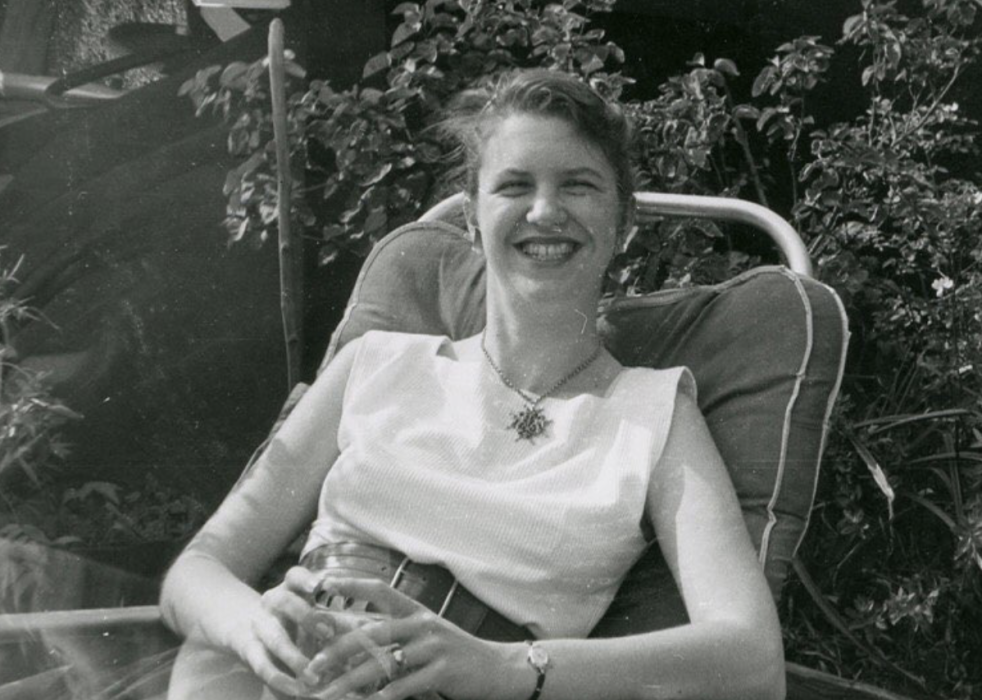
We know from Plath’s journals, Buddy Willard was modeled after her old boyfriend, Dick Norton. For his part, Norton, stayed mostly silent about his time with Plath. Whether he valued and respected their relationship that much or simply did not feel the need to defend himself, we may never know. They had quite a history, growing up, their mothers were fast friends. Dick’s brother, Perry Norton, was very close with Plath and in many ways a better friend. But, Dick, had been so revered by Plath. Heather Clark writes, “Dick was Sylvia’s ideal: blond, blue eyed athletic, intelligent ambitious and a family friend.”1 One has to wonder if Plath didn’t place her frustration with the double standard of the time squarely on Dick Norton’s (Buddy Willard’s) shoulders.2 Males were allowed to have sex before marriage and people looked the other way. Females were supposed to stay true and pure until that ring was on their finger. Plath never appreciated being told she could or could not do something, especially if it was a double standard between the sexes.

So it comes as no surprise that Esther, tough as nails on the outside, cool as a cucumber, and sensible as a New England girl could be, would show no outward emotion at having witnessed cadavers being sliced open, stillborn or aborted babies floating in bottles of formaldehyde for educational purposes, and a live birth. Buddy didn’t blanche at such things, so neither would she.

It’s the hypocrisy of Buddy Willard that breaks her. The fact that she finds out he is not a virgin. Not just that he is not a virgin, but that he slept with “some slutty waitress one summer” named Gladys upwards of 30 times in a single summer season. She is not just disgusted by the fact that he is a hypocrite, but that she is not allowed to unleash her sexual frustration given the standards of the times.

We can tell it was the straw the broke the relationship’s back. Esther had already been trying to find ways to cut Buddy down to size. Spending free time thinking up witty comebacks to put in him in his place, after the fact. When he exposes himself to her, she is disappointed in what she sees referring to his male genitalia as “a turkey neck and turkey gizzards”. She then makes up an excuse to not show him her naked body, as a way to get back at him.

The starkest example of her decaying feelings toward Buddy is illustrated when he tells her he has contracted Tuberculosis. She did not feel sorry for him, but rather relieved, possibly vindicated. As if he brought the disease on himself, by his own hypocritical attitudes and tarnished behavior. Esther has valid human feelings to be sure, but they are complicated.

Humans, even fictional ones, are complex beings. That’s what draws us in, what keeps us engaged. I can’t say we haven’t all met someone we once felt was the most exciting person ever, only to realize we had a lapse in judgment. We can relate to Esther’s evolution of feelings toward Buddy, but that doesn’t mean we have to whole heartedly support it. Instead of saying she would write to him up at the TB colony in the Adirondacks, she should have just cut the relationship off and been done with it then and there for both their sakes. Maybe given the family dynamics that seemed like an impossible thing to do.

Nevertheless, Esther’s choices and attitudes come into question more and more. From food poisoning to poisoning of the spirit. Esther’s state of affairs keeps decaying further. We know it is only going to get worse.
  1. Clark, Heather L. Red Comet : The Short Life and Blazing Art of Sylvia Plath. New York, Alfred A. Knopf, 2020.
    ↩︎
  2. “Sylvia Plath’s #MeToo Stories – Ms. Magazine.” Msmagazine.com, msmagazine.com/2018/02/02/sylvia-plaths-metoo-stories/.
    ↩︎
Uncategorized · Vintage Ads

A Sweet Story

Vintage Advertisement of the Week – August 22, 2024

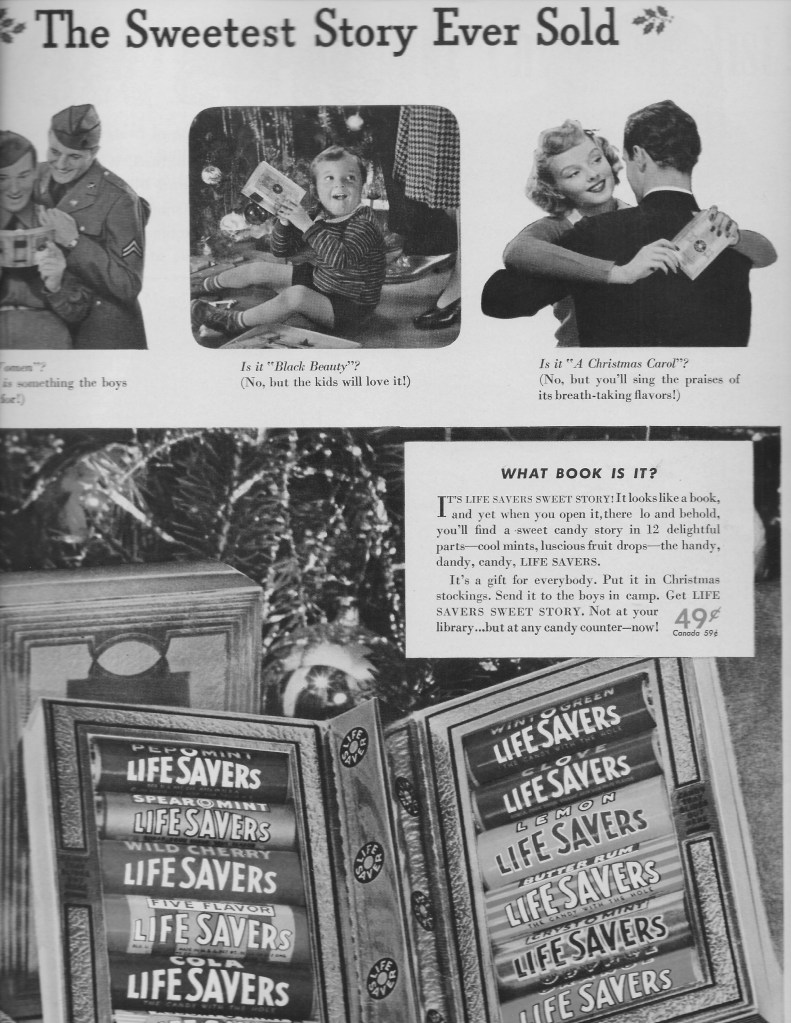
Any kid who grew up in the United States and Canada remembers these treats. The Life Saver Christmas Story Books were an affordable gift to give your friends when you had mere coins to spend on Christmas gifts in the school days of our youth.

This particular advertisement comes from Life magazine’s, December 15, 1941 issue. The candy box contained 12 classic flavors, some now lost to history:

  • Pep O Mint
  • Spear O Mint
  • Wild Cherry
  • Five Flavor
  • Cola
  • Assort O Mint
  • Wint O Green
  • Clove
  • Lemon
  • Butter Rum
  • Chryst O Mint
  • Orange

A Brief History of the Company

Clarence Crane of Cleveland, Ohio, invented Life Savers in 1912 as a summer candy alternative to chocolate. The first flavor was Pep O Mint. They were made with a special punch by a pill manufacturer. The hole in the middle gave the hard candy the look of a life preserver, hence the name Life Saver was born.1

After registering his trademark in 1912, Crane sold the company and the rights to the name to Edward Noble in 1913 for $2,900,2 equivalent to $92,137.90 in 2024 dollars. Life Savers would change hands in the centuries to come several times. Here is a brief outline of how often the company changed ownership:

  • 1912 – Clarence Crane Invents the Life Saver
  • 1913 – Edward Noble buys the company from Crane and expands on the flavors and brand for decades to come
  • 1956 – Life Savers Merged with Beech Nut Packing Corporation
  • 1968 – Beech Nut Life Savers Merged with Squibb Corporation
  • 1981 – Nabisco Brands, Inc. buys Life Savers
  • 2000 – Kraft (a subsidiary of Phillip Morris Companies)buys Nabisco
  • 2006 – Wrigley’s purchases Life Savers from Kraft/Phillip Morris
  • 2008 – Mars acquires Wrigley

Manufacturing Tidbits

The candies used to be wrapped in tin foil to keep them fresh. This was done entirely by hand, until Noble’s brother Robert Peckham Noble, an engineer, designed a machine that streamlined the process. Robert Noble became the company’s CEO for the next 40 years.3

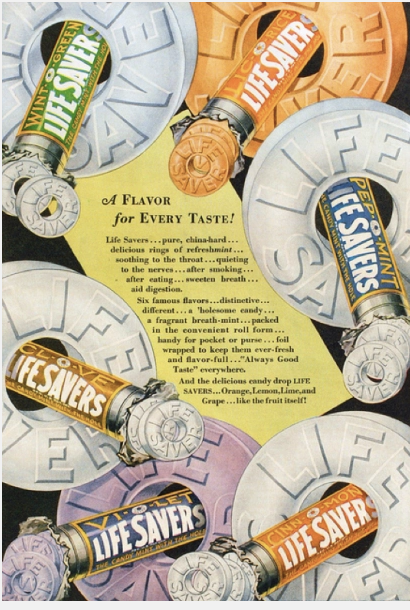
Interesting flavors, now defunct are: Lic O rice, Cin O mon, Vi O let, Choc O let, Hot Cin O mon, Sweet Orange, Sweet Mint and last, but not least, Malt O Milk. Apparently the Malt O Milk (1920) variety was not well received.4 I wish they would bring it back. I would love to try it.

Life Savers Ad; from the 1930’s.

Prices sure have gone up for this holiday treat. In 1941, the Christmas Storybook cost just .49¢ ($10.48 in 2024’s dollars). Walmart is currently selling the gift for $14.59. 5 I suspect this price will drop as the holidays near.

There is a ton of information out there on Life Savers. So many interesting ad campaigns exist for this company throughout the decades. I’ll be sure to post more in the future.

Nearly everyone has a favorite Life Saver memory or flavor. What’s yours? My favorite flavor is Butter Rum. Now if they could only bring back Vi O Let and Malt O Milk. Maybe they would give Butter Rum a run for its money.

  1. Crane, Clarence (1875-1931). http://www.trumbullcountyhistory.com/crane-clarence-1875-1931/.
    ↩︎
  2. “The History of Life Savers Candy.” ThoughtCo, http://www.thoughtco.com/history-of-life-savers-candy-4076664.
    ↩︎
  3. (ThoughtCo.) ↩︎
  4. (ThoughtCo.) ↩︎
  5. “Walmart.com | Save Money. Live Better.” Walmart.com, 2020, walmart.com.
    ↩︎
Uncategorized

One Dimensional to Her Three

As we know, this novel is highly autobiographical. So much so, that it was first published under the pseudonym, Victoria Lucas, for fear of libel suits that might arise. Plath did not disguise or distinguish her fictional characters from their real life inspirations very much at all. I’ll try to avoid making too many comparisons to the characters’ real life counterparts and treat them as fictional beings, unless absolutely necessary. Suffice it to say, Plath created many very one dimensional characters in her book. Doreen and Betsy being two such characters. Doreen was the quintessential bad girl. She was promiscuous and a partier. Betsy was naive, sweet and a country bumpkin. Doreen was exciting and magnetic. Betsy was innocent and drab. Doreen was Esther’s devil. Betsy was her angel.

Lenny Shepard and Frankie are also written with a singular agenda in mind. Lenny is the male counterpart to Doreen. Tall, masculine, attractive, and polished in a citified Western sort of way. He exudes confidence, likening himself to a local celebrity. Frankie, is written with humor, but also at times humorless. Esther paints a picture of Frankie that is comical, yet sad and pathetic. I honestly couldn’t decide if I felt bad for Esther or for Frankie. Granted, Esther didn’t pick Frankie out as her date, Lenny did. It was apparent Lenny owed Frankie one and was trying to do him a favor. A favor Esther obviously didn’t want. No one likes to be set-up on a blind date with someone they found to be off-putting. Esther saw Frankie as unattractive, too short, too ugly, annoying and terribly unfashionable. Esther was so repulsed by Frankie that she gave him a false name, Elly Higgenbottom, because she didn’t want anyone to be able to associate Esther Greenwood with the evening. By the end of chapter 1, Frankie is out of the picture and Esther is more than fine with that.

Betsy is presented to the reader as a Kansas born, corn-fed hick who is boring as sin. Esther’s antidote, where Betsy makes the TV reporter cry over her description of male and female corn, is hilarious, yet demeaning to Betsy all in one swoop. Esther knows she should be friends with Betsy and her crowd. Betsy resembled the girls she hung out with back in college, but she finds Betsy and girls like her (Hilda-Chapter 3) to be dry and lifeless. Not like Doreen, who is the only spark in her immediate circle in New York.

This tendency to present others around her as one dimensional to make herself seem more complex is a direct result of Plath’s own self-awareness. Plath was, without a doubt, a genius. She scored at or above 160 on an IQ test in 1944, when she was only 12 years old.1. Genius grading starts at 140. She clearly possessed a superior brain. She was a tall (5’9), pretty woman, with honey brown hair, quite attractive. Her figure was always trim, but not too thin. She herself said she could eat whatever she wanted and never gain weight. She also was athletic enough to go to a sailing camp, ride horses, and play tennis and basketball in high school. The only subjects she ever slightly struggled with were Gym, German and History. By struggle, I mean she didn’t get a solid A, but instead got a few B’s in junior high. Oh the horrors of not getting straight A’s!2

Plath was immensely hard on herself. She was a perfectionist to the extreme. So much so it affected her mental health at an early age and never really resolved during her life.

It was no wonder she might look down on others that seemed less than her. Yet, all this plays into the other stance, that Plath was a narcissist. She thought very highly of herself, and felt many around her were not as intelligent or worthy of her time. She fixated on people, propped them up on pedestals and knocked them down just as fast. Her journals and diaries are rife with examples of infatuations, boys and girls alike, but mostly boys.3

Plath was extremely secure and insecure at the same time. She was a paradox. It is no wonder, she wrote Esther to be as multilayered as she was. This notion of needing to be perfect is a theme that pops up throughout the novel, and adds to Esther’s decaying mental state. It is a theme the reader cannot escape.

  1. Leha. “Sylvia Plath and How Mental Illness Is Romanticized.” THE LITERARY AFFAIR, 31 Mar. 2021, theliteraryaffair.com/2021/03/31/sylvia-plath-and-how-mental-illness-is-romanticized/.
    ↩︎
  2. Wilson, Andrew. Mad Girl’s Love Song : Sylvia Plath and Life before Ted. London, Simon & Schuster, 2013.
    ↩︎
  3. (Wilson) ↩︎
Uncategorized

Plath’s Use of Thematic Description

While reading The Bell Jar this time around, I noticed the first three chapters have descriptive themes.

  • Chapter 1 – Attire
  • Chapter 2 – Surroundings
  • Chapter 3 – Gastronomy

In Chapter 1 we get no further than Page 2 before Plath sets her sights on apparel. It is a well known fact, Sylvia Plath was obsessed with clothes and envied the rich girls at Smith. Girls who didn’t have to worry about maintaining their scholarships, because their parents paid for their schooling out of very deep pockets. Plath came from a lower-middle class family and had to take jobs during the summer. She saved money for college and clothes by nannying for the wealthy Mayo family, working in a field as a farmhand and waitressing during summers.

I counted no fewer than twelve instances in Chapter 1 alone where Plath details apparel to illustrate Esther’s opinion about herself or people around her.

Chapter 1 – Apparel

“…uncomfortable, expensive clothes, hanging limp as fish in my closet.” Page 2

“…tripping around in those same size seven patent leather shoes…black patent leather belt, black patent leather pocket book.” Page 2

“…skimpy, imitation silver-lamé bodice stuck to a big fat cloud of white tulle…” Page 2

“…posh secretarial schools like Katy Gibbs, where they had to wear hats, stockings and gloves to class…” Page 4

“…all the girls had pocketbook covers made out of the same material as their dresses, so each time they changed their clothes they had a matching pocketbook.” Page 5

“Doreen lounged on my bed in a peach silk dressing gown…” Page 5

“-the rest of us had starched cotton summer nighties and quilted housecoats, or maybe terry-cloth robes that doubled as beachcoats, but Doreen wore these full length nylon and lace jobs you could half see through and dressing gowns the color of skin, that stuck to her by some kind of electricity.” Page 5

“She (Doreen) was wearing a strapless white lace dress zipped up over a snug corset affair…” Page 7

“I wore a black shantung sheath that cost me forty dollars ($470 US dollars in 2024!)…the dress was cut so queerly I couldn’t wear any sort of bra under it…” Page 7

The New York Public Library Digital Collections. 1957. https://digitalcollections.nypl.org/items/04b53740-a8c2-0132-5c95-58d385a7bbd0

“When a man in a blue lumber shirt and black chinos and tooled leather cowboy boots started to stroll over…” Page 8

“…white lace pocketbook cover.” Page 8

“The thought of dancing with that little runt in his orange suede elevator shoes and mingy t-shirt and droopy blue sports coat made me laugh. If there’s anything I look down on, it’s a man in a blue outfit. Black or gray, or brown even. Blue just makes me laugh.” Pages 11-12

I won’t note each and every instance or Chapters 2 and 3, as reading list borders on tedium. Rather, I will simply note some of my favorites.

In chapter 2 surroundings become instrumental. Esther’s self-proclaimed alter ego, “Elly Higgenbottom”, is intrigued by Lenny’s pine paneled apartment with dead animal artifacts scattered or hung everywhere. I found it interesting that Esther tells us her drink becomes more depressing with each sip. She refers to it as “dead water”. More likely her situation around her becomes more depressing with each passing minute. One has to wonder if her drink takes on the presence of the dead animal heads and skins surrounding her, as she shrinks into the background.

Doreen’s smoke lingers in her room back at the Amazon, making her feel furious and frustrated upon her return.

The china white telephone, normally a lifeline, sat still and “dumb as death’s head”.

Her only saving grace in the entire chapter is a hot bath. She considers each and every bathroom she has bathed in during her life, and in great detail. The pink marble, griffin legged tubs, and coffin shaped tubs all spring to her mind. I find it interesting she recalls one tub as being “coffin” shaped. I had to look it up. This is a way to describe your standard single person fiberglass tub. Nevertheless, again with the reference to death.

She ends the chapter by describing the green hall carpet covered in Doreen’s jet of brown vomit, while Doreen’s blonde hair dabble into the vomit like “tree roots in a bog.” I just love that line.

Chapter 3

Photo Credit: Irenna at : https://pixabay.com/photos/black-caviar-caviar-fish-roe-7274201/

All about food…Plath is obsessed with food. Her journals and letters are littered with accounts of what she ate while at camp, on vacation, at school and just on the normal day to day. So it’s no surprise Plath makes Esther keenly aware of food. But not just any food. Food at the Ladies’ Day luncheon.

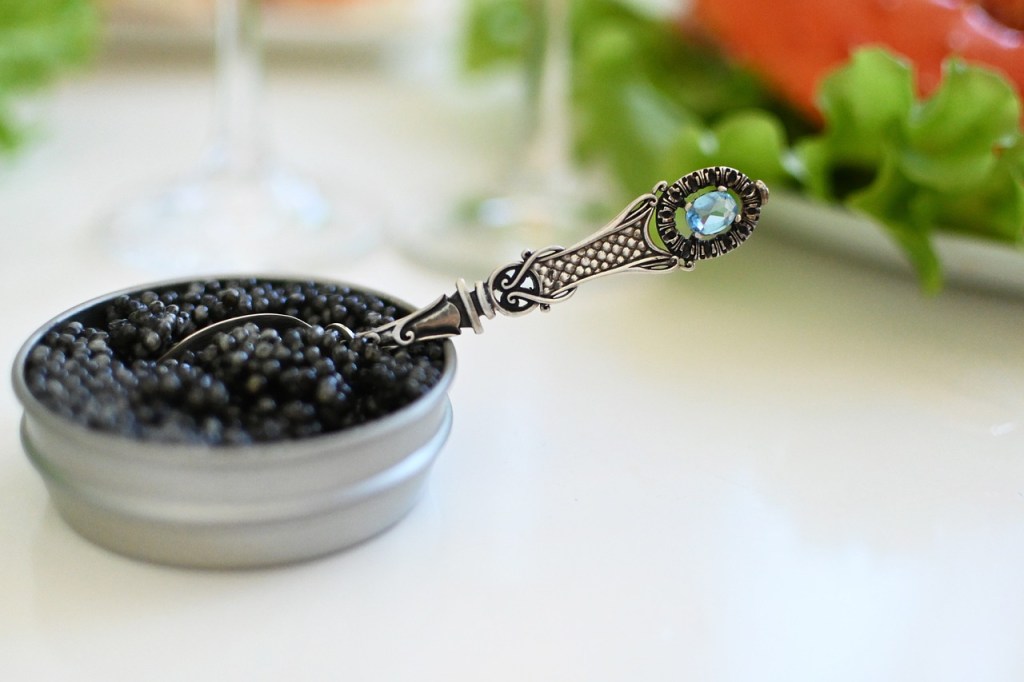
Yellow-green avocado pear halves, stuffed with crabmeat and mayonnaise, black gleaming caviar heaped in cut glass bowls1, and mountains of marzipan fruits are juxtaposed against memories of a blue collar burger, fries and vanilla frappes eaten at the hometown Howard Johnson’s (think Denny’s of today). She tells us about the guilt her grandmother doled out while eating supper. Making sure they all knew just how expensive each bite of meat cost.

Esther informs the reader she can eat whatever she wants and never gain a pound. (Plath often said that about herself. Don’t we all wish?) Dishes laden with sour cream, butter and cheese being her favorites.

This chapter is a particularly amusing one to me. Especially in the way she highlights the others sitting around the table, like they were all just taking up space (sad replacements for her wild and exciting friend, Doreen), as well as the way she introduces us to her boss, Jay Cee. More about those around her in another post when we touch on Esther’s depression and narcissistic tendencies as Plath highlights them through secondary characters.

One last note on food. My favorite part of Plath’s inclusion of food in Chapter 3 is when Esther is silently crying and eating her meringue and brandy ice cream. Not because it is funny, but because it’s relatable. She eats her own ice cream then absentmindedly makes swift work on Betsy’s proffered bowl. I think we have all been there. Eating mindlessly as we work through our worries.

  1. Does this make anyone else think of F. Scott Fitzgerald’s Story The Cut Glass Bowl, first published in Scribner’s Magazine in May of 1920? https://americanliterature.com/author/f-scott-fitzgerald/short-story/the-cut-glass-bowl/#google_vignette ↩︎

I would love to hear your favorite parts of Chapters 1-3. Did you have a favorite description?

Uncategorized

There Will Come Soft Rains – Sara Teasdale

(War Time)

There will come soft rains and the smell of the ground,
And swallows circling with their shimmering sound;

And frogs in the pools singing at night,
And wild plum trees in tremulous white,

Robins will wear their feathery fire
Whistling their whims on a low fence-wire;

And not one will know of the war, not one
Will care at last when it is done.

Not one would mind, neither bird nor tree
If mankind perished utterly;

And Spring herself, when she woke at dawn,
Would scarcely know that we were gone.

Originally published in Harper’s Magazine, July 1918

Uncategorized

The Rosenbergs, Executions, and Foreshadowing

https://www.theguardian.com (Picture Credit)

“It was a queer, sultry summer, the summer they electrocuted the Rosenbergs, and I didn’t know what I was doing in New York. I’m stupid about executions.”

Just like that, bang! Can we take a second to appreciate the emotion that weights down those two simple, yet well crafted sentences?

It took my second time of consuming this book (I’ve read it two times and listened to the audiobook twice) to understand why Plath started her novel off with these sentences. Of course, hindsight is 20/20. Why talk about the Rosenbergs being executed? What does it have to do with the main character’s situation as it stands in New York during 1953? To date the novel? Perhaps. Yet, why employ executions as the bridge for the narrator to question why she is in New York? Even before the end of the first sentence, we know she is discontent. Instead of being excited she won the privledge to work at a prestigious magazine, she’s wondering why she was even there. She goes on to say at the end of that same paragraph, “It had nothing to do with me, but I couldn’t help wondering what it would be like, being burned alive all along your nerves.” Foreshadowing? Maybe. Most likely. What do you think?

No matter how you dice it, that first paragraph paints a picture of gloom and despair.

Later she goes on to say, “I knew something was wrong with me that summer, because all I could think about was the Rosenbergs, and how stupid I’d been to buy all those uncomfortable, expensive clothes hanging limp as fish in my closet…” The narrator is having an obvious preoccupation with death. The clothes hanging like a string of dead fish on a line serves to add to the imagery.

Another obvious note of discontent comes to us as early as page two. “And when my picture came out in the magazine the twelve of us were working on…everybody would think I must be having a real whirl.” It is obvious she was not having a whirl. She goes on to express, “only I wasn’t steering anything, not even myself.” She is empty and rudderless.

Heavy, powerful stuff to start a novel off with, and we haven’t even made it to page 3.

What did you notice in these opening pages? What mood do you feel Plath was trying to infuse into the reader? Did her opening grab you, or did it take a while for you to feel engaged with the narrator?

If this is a revisit reading this novel, do you recall where you were when you read the opening pages for the first time? I can. I was at the corner down from my house heading south, walking my dog. I was listening to Maggie Gyllenhaal’s narration of the audio book. Just an aside – if you haven’t listened to this version, I cannot recommend it enough. Gyllenhaal’s wry delivery is unparalleled. It was so powerful, I can scarcely read the words on my pages without hearing Gyllenhaal’s voice. As I reread this book have to train my brain to use its own imagination to craft my own voices for Plath’s characters. If you know of a better audio book version please let me know. I welcome hearing other approaches.

The first few pages set the stage for what feels could be a heavy, humorless tome. Yet, somehow, Plath proves this assumption incorrect. Her humor quickly shows in the first chapter as she expands her cast of characters.

Next up, Doreen, Betsy, Lenny Shepherd, and Frankie.

Uncategorized

Best Novels of the 20th Century?

“Best” is such a subjective word. A theme may resonant firmly with Mrs. X, while not at all with Mr. Z. If a theme leaves us feeling listless or without spark, we may rely on a character to pull us through. Yet, we must be able to connect to a character in order to feel invested in them. Without investment our interest often wanes and dies. Our only hope to enjoying a book without a character or plot connection is if an author’s writing is so strong, unique, or pointedly beautiful that we can forgo all else.

We’ve all been burned by and had DNF (Did Not Finish) experiences with books. I can think of more books than I have fingers and toes that I struggled to get through. But what of those books that we flew through and knew we would read again and again? The ones who writing made us sit and think for days? Whose writing left us feeling as if we were in a spell? The ones we keep on our physical book shelves, because they are too precious to donate to the local thrift store or little library? These well loved favorites that we treasure like the air we breathe? The ones where we felt the writer nailed something on the head like no-one before or after ever will?

Instead of listing what I feel may be the “best” novels of the 20th century, I will share my favorites. They are, not in any order:

  • The Bell Jar – Sylvia Plath
  • Catcher in the Rye – J.D. Salinger
  • The Great Gatsby – F. Scott Fitzgerald
  • Charlotte’s Web – E.B. White

All four have one similarity that weave in and out of their work. The obvious theme of being young and discontent. This feeling of wanting more in life than what we have at present is what makes us want to lie down and quit, but also drives us to achieve more. Haven’t we all felt like this at some point in our lives?

I plan to revisit each novel, in turn between now and September of 2025. I urge you to join me. Join the journey. Join the discussion. None are lengthy, and most are quick reads. I’ll start with The Bell Jar by Sylvia Plath. If you haven’t read this book, I highly recommend it. It has so many passages that will make you sit up and think or lose sleep. People marvel at Plath’s turn of phrase in her poetry, which was without a doubt unparalleled, but what she accomplished with The Bell Jar is absolutely amazing in its own right.

I welcome comments from you as we read these together. What hits home? Have you ever felt like the Esther? Is there anything you feel detracts from the flow of Plath’s novel? Feel free to post your favorite quotes or passages from the book as we read The Bell Jar.

I encourage you to share your favorite books of the 20th century. Your list and comments are appreciated below. Let’s have a free, open and respectful discussion about our favorite books.