William Butler Yeats – Published in the Little Review, June 1917 Issue
The trees are in their autumn beauty, The woodland paths are dry, Under the October twilight the water Mirrors a still sky; Upon the brimming water among the stones Are nine-and-fifty swans.
The nineteenth autumn has come upon me Since I first made my count; I saw, before I had well finished, All suddenly mount And scatter wheeling in great broken rings Upon their clamorous wings.
I have looked upon those brilliant creatures, And now my heart is sore. All’s changed since I, hearing at twilight, The first time on this shore, The bell-beat of their wings above my head, Trod with a lighter tread.
Unwearied still, lover by lover, They paddle in the cold Companionable streams or climb the air; Their hearts have not grown old; Passion or conquest, wander where they will, Attend upon them still.
But now they drift on the still water, Mysterious, beautiful; Among what rushes will they build, By what lake’s edge or pool Delight men’s eyes when I awake some day To find they have flown away?
Vintage Advertisement of the Week – September 19, 2024
Seventeen Magazine – November 1948
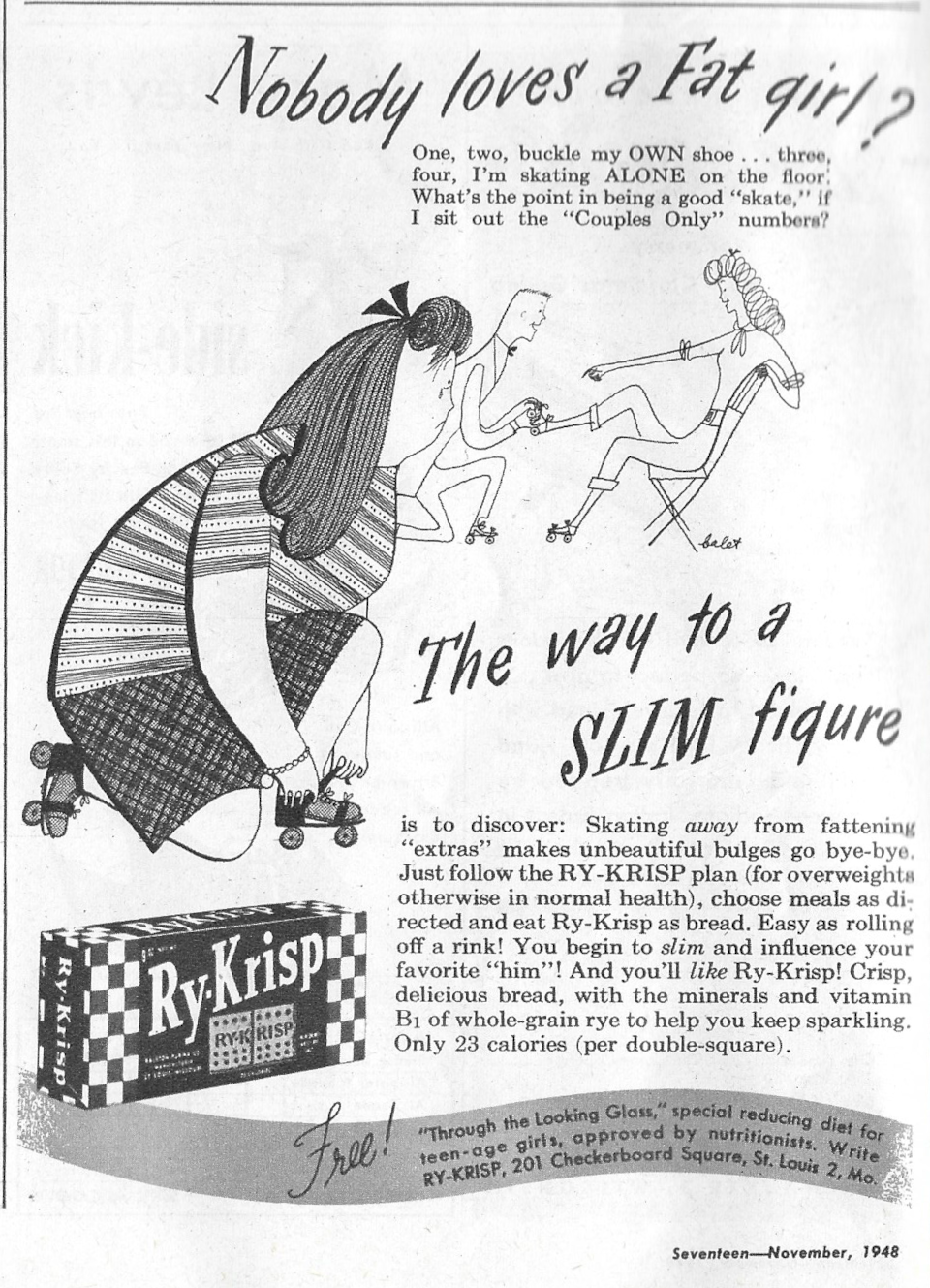
Talk about traumatic! Marketing executives of the 1940’s were keen on throwing shade anywhere and everywhere they could get it to land and this ad has a whole lot of shade.
Have you ever eaten rye crackers? They are rather bland. In the world of manufactured snacks, they are at best forgettable and only as good as what you dressed them up with. It’s reminiscent of the 1980’s rice cake diet fad. Anybody remember that? I digress. If I had to guess, I would say they were so successful for two reasons; 1) Scandinavian Americans adored the crackers, and 2) Ry-Krisp’s diet campaign.
A Brief History of Ry-Krisp
Ry-Krisp was founded by Arvid and Erik Peterson, brothers who immigrated to the United States from Sweden in the 1800’s. They brought with them a recipe for knackerbrod. Knackerbrod was a 19th century Scandinavian staple. It was made twice a year, had no yeast and kept an incredibly long shelf life. Best known as being a digestive biscuit, it was baked with a hole in the middle so it could be stored on a long rod for the best drying practices.1
The Peterson brothers settled in Minneapolis, Minnesota, a veritable hub for Scandinavian immigration during the mid to late 1800’s.2 A few key historical highlights of the company:
1904
Peterson Brothers open up a bakery on Lyndale Avenue, Minneapolis, MN.
1913
The Peterson Brothers sell to a local investment group, changing the name of the company to Ry-Krisp.
1926
Ralston Purina (of dog food fame) buys out Ry-Krisp and markets it as a health food. 3
2013
Conagra acquires Ry-Krisp, shutters factory in Minneapolis two year later and production of the cracker ceases.
The Petersons and their vision for a marketable rye cracker fit right in with Minneapolis of the late 1800’s. Minnesota, especially Minneapolis, was a center of flour mill activity. It was home to Gold Medal Flour/General Mills4, Pillsbury Flour5, and Malt O Meal (Northfield, MN, n/k/a Post Consumer Brands)6. It was big business back in the day and still is. Here is a photograph from 1949 taken of one of the machines that helped make the Ry-Krisp cracker.7 I wonder how the paste made it from this machine to cracker form. It’s too bad footage of the entire process doesn’t exist.
Premade or convenience foods helped liberate the modern woman of the late 1940’s and 1950’s.8 The rye cracker also grew in popularity throughout the United States (rye being a staple grain in not just Norway, Sweden, and Denmark, but much of Northern and Eastern Europe). I can see why Ry-Krisp lasted for over a century.
Due to its long shelf life and convenience, Ry-Krisp really got around. Salad with Ry-Krisp while you travel down the tracks in luxury?
A fun look at a recreation of a menu based off the old Pennsylvania Railroad menus. Check out the luncheon offerings. The New York Public Library Archives have some other fun glimpses into past
The Untapped Teen Market
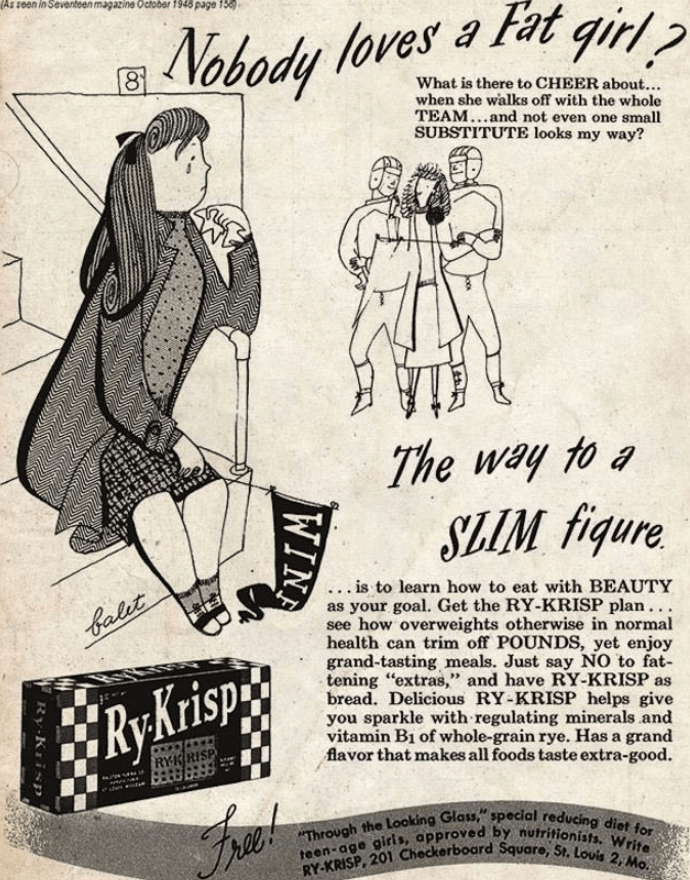
Convenience aside, the teen market executives hung their shingle solely on two words, “loneliness” and “diet”. Magazines like Seventeen and Calling All Girls are littered with ads that preyed on a young girl’s doubts toward her body size and being ostracized because of it.
Here are some other examples of how marketing sharks sunk their blood thirsty teeth into a young girl’s confidence:
Ry-Krisp Ad, Widely Circulated 1948
Calling All Girls – July 1947
Through the Looking Glass
I’ve got a 1945 copy of “Through the Looking Glass” a 1,500 calorie diet for teenage girls coming in the mail. I’ll share tidbits in the coming months. The advertisement from which I purchased the pamphlet says it calls for a 1,500 calorie limit for 16 year old girls who want to lose weight the Ry-Krisp way. While it might be doable, suggesting a diet to a person, teenager or not, should be up to the medical professionals, not the Mad Men of the snack world. It’s a dangerous line to walk, but advertisers do it all the time.
The common themes in all of the teenage Ry-Krisp ads above are cruel and insidious. Flat out telling a young girl she will be alone because she is “overweight” and needs to reduce her body by eating their product is nothing new, but it is the way they are so in the reader’s face about it. Marketing these days is bad enough, but I’m not sure I’ve seen ads from the 2020’s as bad as these Ry-Krisp ones.
Back to the question above. Can a fat girl find love? I think we all know the answer to that. Yes, yes, they can, with or without the help of rye crackers.
1a : the power of faculty of attaining to direct knowledge or cognition without evident rational thought and inference
b : immediate apprehension or cognition
c: knowledge or conviction gained by intuition
2 : quick and ready insight
Our main character, Esther Greenwood, seems obsessed with three things up to this point, possessing intuition, achieving success and being perfect. She mentioned Buddy Willard possessed no intuition. Besides being a hypocrite, it was his major failing. Contrary, Constantin, has intuition. Esther realizes it the second she mets him in the flesh. At the end of the first paragraph of Chapter 7 Esther thinks, “He had what no American man I’ve ever met has had, and that’s intuition.”
Perhaps possessing intuition is to Esther (and potentially Plath) like being inherently intelligent. She seems to hold it in very high regard. She sees being unintuitive on par with being a failure.
Speaking of failings, Esther remains very preoccupied with all the things she cannot do. Greenwood’s character is extremely critical of herself. Esther finds herself envious of nearly every one else on some level. With specificity, she lists her failings in Chapter 7.
Things Esther cannot do or skills does not possess:
Cook
Take Down Shorthand
Dance
Sing in Tune
Balance
Ride Horseback
Ski
Speak German or Russian, Read Hebrew or Write Chinese
No Knowledge of Geography
This litany of failings is given to the reader on the heels of knowing Esther has many talents other young women her age may not have held. Not only did she win a scholarship to be a guest editor at a high profile magazine in New York City for a month, but she was quite an accomplished person before she won her editorship. She tells the reader she participated in or learned to do the following while growing up:
Win Scholarships and Academic Awards
Earn Straight A’s
Girl Scout
Played Piano
Painted with Water Colors
Took Dancing Lessons
Went to Sailing Camp
Attended Rowing Camp
The above activities don’t sound like the types of passtimes down and out people with no skill set do. They sound like the kind of activities very driven young people would do that need to be challenged.
Esther’s biggest failing is that she is a perfectionist. Begin perfect was her driving factor up to this point. She finds it difficult to live with even the smallest thing she might consider a flaw. It’s twofold, on the one hand she cares when she recognizes what she feels may be a shortcoming, but also is beginning to find the entire thing pointless. What will become of her when no more scholarships are to be won, she asks herself in Chapter 7.
Furthermore, her desire for Constantin to sleep with her, removing the yoke of her virginity once and for all, is displayed in utter disappointment when she wakes up with both of them fully clothed in his room. She comes right out and admits it’s a contest with Buddy, but sleeping with Buddy wouldn’t count as he would be “one person ahead of her (the waitress)”. Esther is so damn competitive about everything she cannot handle being in anything less than first place. Winning is everything. Winning contests, winning the best grades, winning the most admiration from others.
Picture of Plath Circa the Early to Mid-1950s. (Not a hair out of place. We see where this idea of perfectionism comes from. The author, without a doubt.)
Having others see her in an adoring light is why she never tells the other guest editors what she really thinks, but lets Doreen be the bad guy. Doreen is the slut. Doreen speaks her unfiltered mind. Doreen is trashy. Esther is not. Esther is above it all. Or, so she acts. If Esther had been able to call Betsy “Pollyanna Cowgirl” to her face it would have meant losing Betsy’s respect and approval. Something Esther’s character cannot handle from anyone. Even Buddy keeps getting strung along far too long. Esther should have made her feelings clear ages ago, but she keeps making him think they have a future together while he takes his cure up at the TB colony in the Adirondacks.
Esther is a coward and weak in many ways. A calculating girl, but a coward nonetheless. She sees sleeping with Constantin not only as a one up on Buddy, but also his mother, as she was the one who set Esther and Constantin up.
Pureness is a term that gets thrown around a lot the second half of Chapter 7. To be pure is to be unmixed with anything else; to not be contaminated. Being pure gives the connotation of being perfect. Esther has to this point been pure. But she is starting to question the duplicity of being so. Why do woman have to be pure before they are married, but men can be held to a double standard? It nags at her tremendously.
Circling back to perfectionism. Esther not only wants perfection in herself, but also in the men she dates. She recognizes Constantin was the “most beautiful man she had ever seen”, but that she knew he would sink into ordinariness if he loved her, just like Buddy Willard had and others before Buddy. She wants what is not possible for herself personally and in a male partner. She holds everyone to such a high standard, it’s no wonder she’s on the road to a nervous breakdown. People have flaws. People make mistakes. People are not pure. It’s not in the cards dealt with humanity.
The cracks grow wider. The breakdown is only a matter of time. With such high exacting standards how can it not be inevitable?
Vintage Advertisement of the Week – September 12, 2024
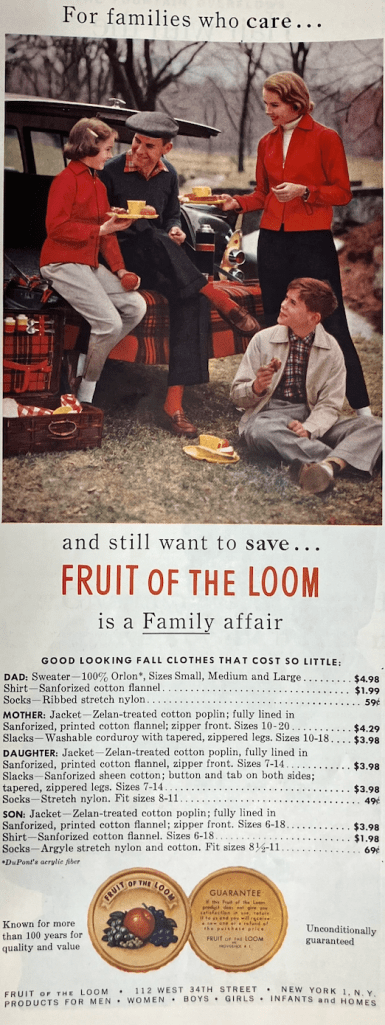
Vintage Advertisement taken from the Ladies Home Journal – October 1956.
It all started in Warwick, Rhode Island, back in 1851. Two brothers named Robert and Benjamin Knight purchased a mill and started spinning cotton into cloth to make undergarments and affordable clothing.1 Thus, cotton became the fruit of the loom.
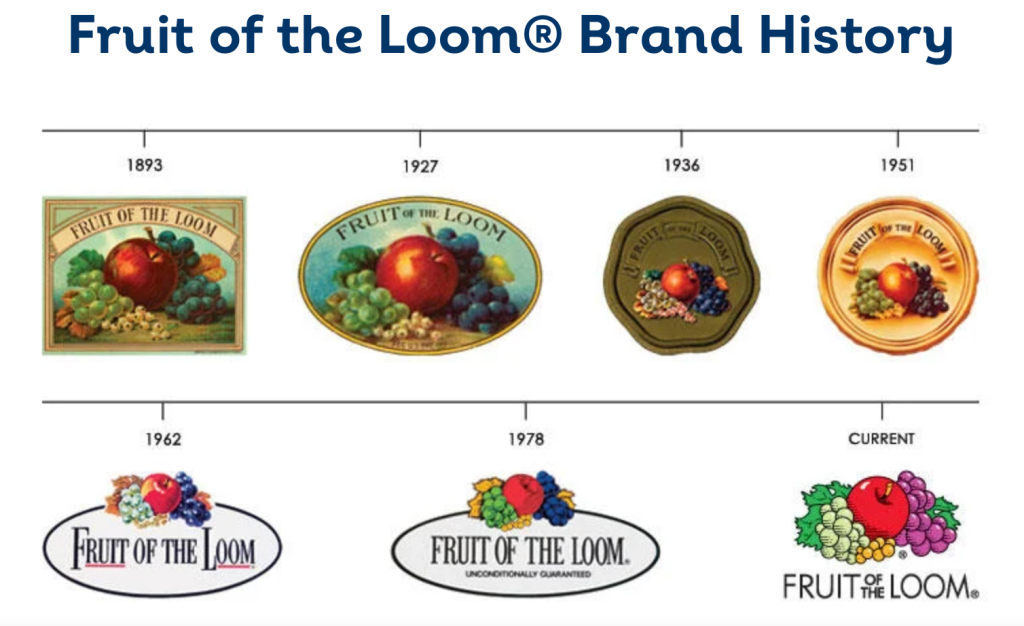
The iconic brand’s trademark, fruit piled up aplenty, was designed in stages and over the years. (Note, when we think of Fruit of the Loom, our brains automatically insert a cornucopia. The truth is there is no evidence Fruit of the Loom ever used a cornucopia as their trademark. Just like the Monopoly Man never wore a monocle. it’s our brains getting confused with Mr. Peanut. In the case of Fruit of the Loom, it could be our brains getting confused with a Thanksgiving centerpiece. I digress…) The origin story lands squarely on the shoulders of Rufus Skeel’s daughter, Jessica Skeel. Rufus was a cloth merchant from Providence, RI. While visiting the factory with her dad, Jessica painted fruit on bolts of muslin clothes the company was to use. The marketing department found out the products that had her painted fruits on them sold more than the plain items. Jessica started out by painted a swaar apple, a fruit her family enjoyed.2
The Fruit of the Loom logo has changed over the last century. But fruit has always been its focal point.
The goal of Fruit of the Loom during the mid-20th century onwards was to sell high quality, affordable undergarments. The biggest innovation for the underwear industry, besides affordable pricing and high quality, was the 3-pack. They began selling men’s boxer briefs in 3-packs in the 1940s. They were also the first underwear manufacturer to advertise on television in the 1950s.
Fast forward to the 1980s. Anybody else remember the Fruit of the Loom Guys? They were eerily similar to the Kool-Aid Man. Check out this cheesy commercial featuring them in 1987, complete with David Allen Grier no less! I’m trying to figure out what the guy in the brown is supposed to be. A raisin? A date? A pineapple? If you know, please put me wise.
There are so many highlights to a company that has been around for over a century and is still going strong. From their partnership with sports leagues and clothing manufacturers (baseball and basketball) to their helping make parachutes for the Allied Troops in WWII, to providing for the everyday American, they really made their mark on the clothing industry. Check out a fun timeline just some of Fruit of the Loom’s highlights over the years here.
Back to the vintage ad at the very top. The guys look like they are straight out of Leave to Beaver or Father Knows Best. Even going causal back then was keen. Everyone looks so crisp and put together.
I am honestly salivating over the simple elegance of the outfits the mother and daughter have on. It looks like they are ready to go camping in very comfy, yet spiffy clothes. Where oh where can I get some Fruit of the Loom corduroys for $3.98 and a snazzy red zip up jacket like that for only $4.29. When I do the math, it’s not as cheap as it sounds. That would be $46.06 and $49.56 respectively. Yet, for high quality, comfortable, nifty clothes, I would pay it. Maybe it’s not outlet prices, but it’s not too far off the mark.
The ad at the top really hits home to the driving force of apparel purchasing power in the 1940’s, 1950’s and onward. It is speaking directly to the matriarch of the family. Advising her to buy Fruit of the Loom for her entire family. If she does it shows she cares. It also shows those around her family that they have good, yet sensible taste. What else would you expect from a century old company founded in the heart of New England? Sensible, practical, quality made goods.
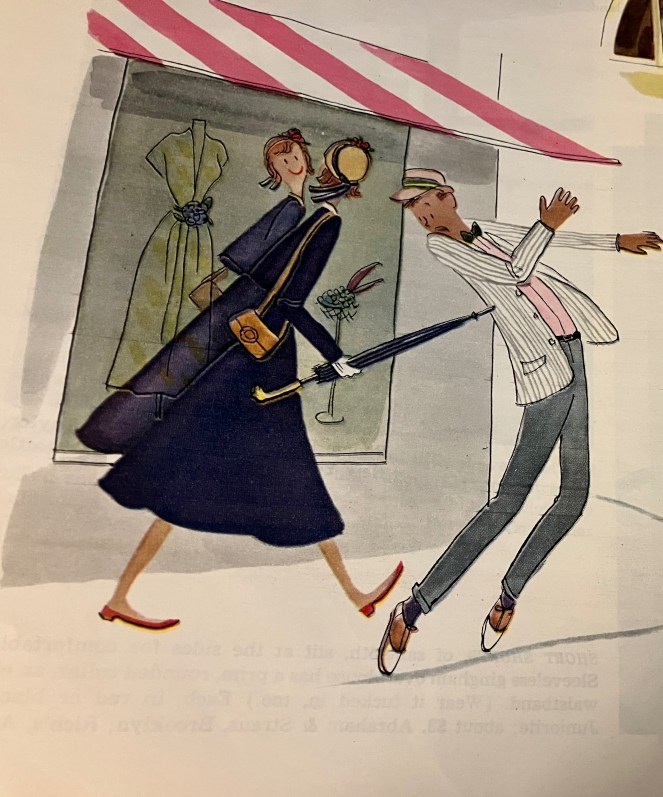
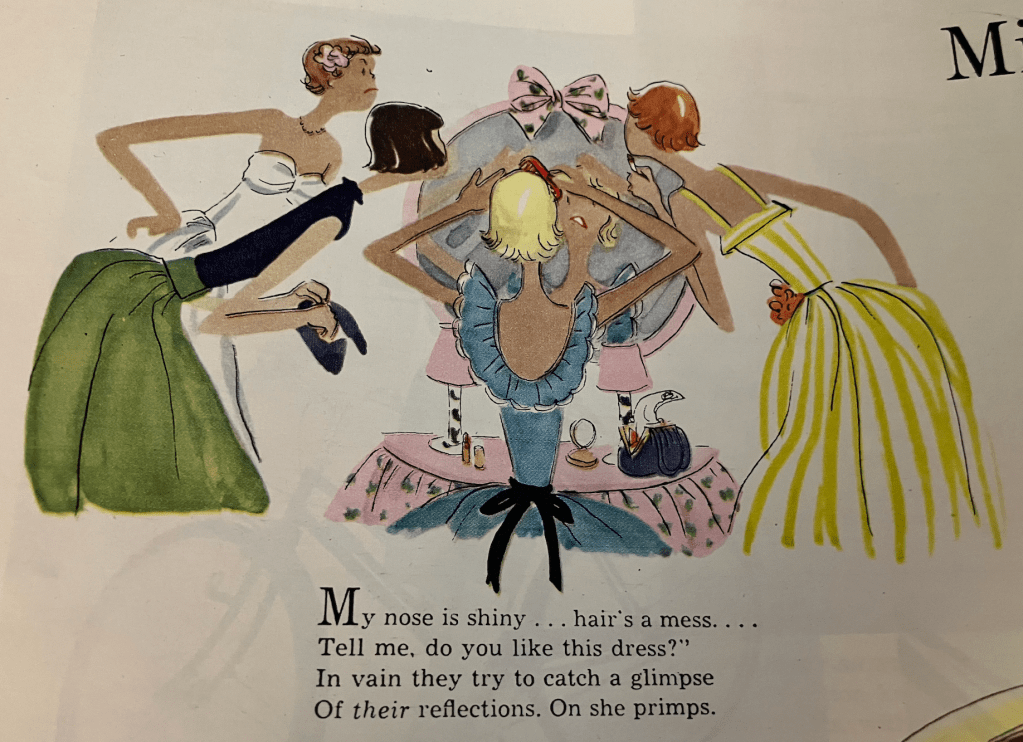
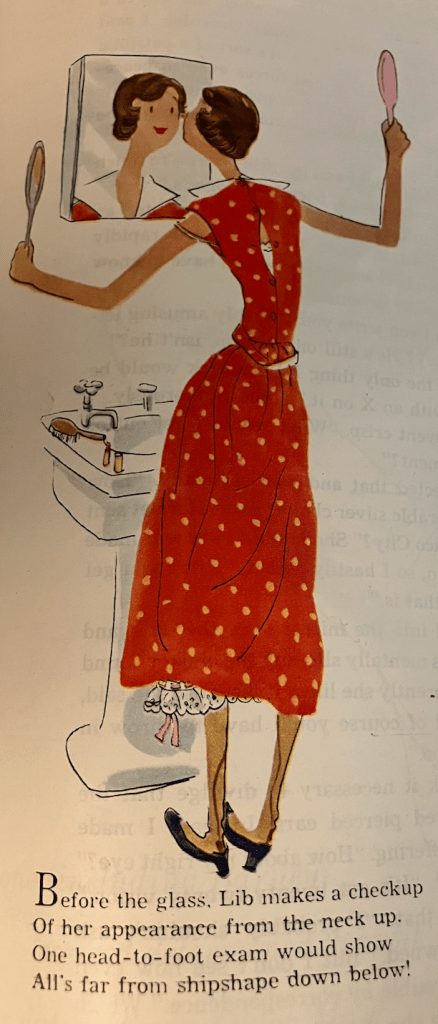
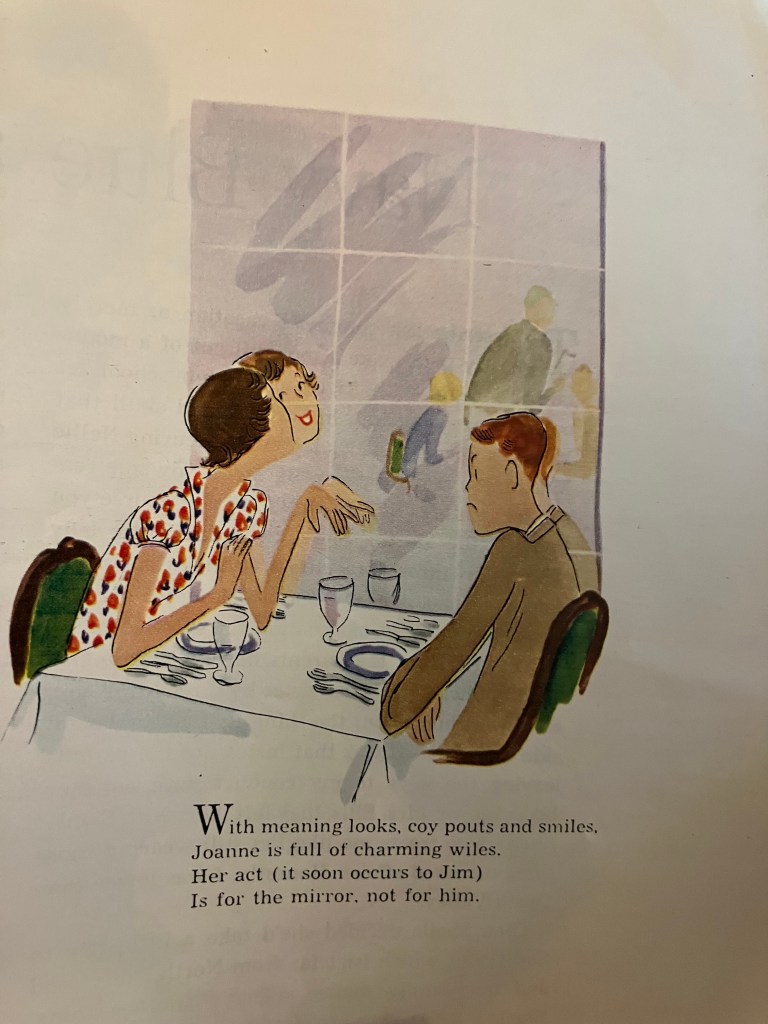
From the June 1950 – Seventeen Magazine “How to Be Pretty Issue” Drawings by Annabel Hagyard – Verses by Barbara Moench
Every month, during the late 1940s and early 1950s Seventeen Magazine put out a cute two page spread focusing on a theme. The intent was to teach proper femnine etiquette through adorable persuasion.
Barbara was an assistant literary editor for Seventeen. I’ve yet to find much on Annabel Hagyard, except for a reference to a publication titled, “Art Directors Annual of Advertising” from 1948.
June 1950’s theme was vanity. I plan to post a picture a day from this spread, just for a fun visual coffee break. There are six pictures with accompanying verses in all on vanity.
Cartoon art is so incredibly mid-century Americana and such a joy to look at.
Vintage Advertisement of the Week – August 29, 2024
Christmas in July: Cologne, Cologne Spray Mist and Dusting Powder (Seventeen Magazine, July 1960). (Cologne, Mist and Dusting Powder by Monico Inc. New York a subsidiary of Bourjois of an Evening in Paris fame.)
Can’t you just imagine the ad campaign board room when this beauty was proposed? A bunch of suits sitting around with a bottle of green perfume perplexed. How the heck they are going to promote it? Who will buy it? Mature ladies already love an Evening in Paris and Chanel No 5. They know the market for teen scents can be expanded, but how? Let’s listen in…
“Hey, Mike, what the hella’ we gonna do with this?” Sam asks passing the bottle over.
“Beat’s me, Sam.” Mike scoffs tossing it to Don.
Don takes a drag on his Winston cigarette, turning the bottle over in his meaty hand. Ash falls absentmindely onto the oak table they are sitting around. Don ignores the ash as he robotically places the bottle in front of him, taking another drag on his smoke. Then placing his cigarette in the company ashtray in front of him, he uncaps the bottle and sprays some perfume onto his business card. Don takes a whiff and passes over to the other men. They each inhale the floral array in turn. Sam sets the card before him and tents his fingers together in thought.
“Christmas in July,” Sam mutterers. “What the hell was Monico thinking?”
A heavy silence falls on the group.
Finger snap, “I’ve got it!” Don exclaims all abuzz. “Let’s build off the green theme of Christmas and the cologne. We’ll capture a young 16-something, sexy bathing beauty type swimming in the ocean.”
“Like a mermaid?” Mike asks.
“Yeah,” Don agrees. “Only without the tail. That tail would cover too much. That’s no good. Got to show off her gams, in a skimpy, skin tight suit. One of those nylon jobs.”
“Green suit?” Mike proposes.
“What else?” Don says. “But the same green as the water, so it looks like she’s barely wearing anything at all.”
Sam taps his pen on the board room table in consideration. “It’s good, but it could be better.”
“How so?” Mike asks.
“What if, we have her swimming toward the bottle of cologne?” Sam proposes, finally adding substance to the conversation, earning his paycheck for the day.
“Words. Give me words, boys,” Don asks.
The trio starts brainstorming off one another, “merry, holiday, green, cool, balmy, ocean,” are all tossed about. Suddenly, Mike smacks his open palm on the oak table. He’s going to knock it out of the park.
“Wait! I’ve got it,” he exclaims excitedly, “she isn’t swimming toward the bottle she’s swimming toward a tree. A fully trimmed Christmas tree at the bottom of the ocean!”
“Brillant!” Sam and Don agree, pleased with how smart, hip and fresh they are. Any yutz could have thought of the bottle, but a fully trimmed Christmas tree, that’s gold. They know this younger generation better than they know themselves. They know what they need to feel appealing to the opposite sex. To feel attractive and wanted. Christmas in July, that’s what they need.
All three sit back in their swivel chairs, throughly convinced they are onto something big. They caught the next big wave in marketing – underwater campaigns. They are going places.











 Tidbits and Timemachines