Uncategorized

One Dimensional to Her Three

As we know, this novel is highly autobiographical. So much so, that it was first published under the pseudonym, Victoria Lucas, for fear of libel suits that might arise. Plath did not disguise or distinguish her fictional characters from their real life inspirations very much at all. I’ll try to avoid making too many comparisons to the characters’ real life counterparts and treat them as fictional beings, unless absolutely necessary. Suffice it to say, Plath created many very one dimensional characters in her book. Doreen and Betsy being two such characters. Doreen was the quintessential bad girl. She was promiscuous and a partier. Betsy was naive, sweet and a country bumpkin. Doreen was exciting and magnetic. Betsy was innocent and drab. Doreen was Esther’s devil. Betsy was her angel.

Lenny Shepard and Frankie are also written with a singular agenda in mind. Lenny is the male counterpart to Doreen. Tall, masculine, attractive, and polished in a citified Western sort of way. He exudes confidence, likening himself to a local celebrity. Frankie, is written with humor, but also at times humorless. Esther paints a picture of Frankie that is comical, yet sad and pathetic. I honestly couldn’t decide if I felt bad for Esther or for Frankie. Granted, Esther didn’t pick Frankie out as her date, Lenny did. It was apparent Lenny owed Frankie one and was trying to do him a favor. A favor Esther obviously didn’t want. No one likes to be set-up on a blind date with someone they found to be off-putting. Esther saw Frankie as unattractive, too short, too ugly, annoying and terribly unfashionable. Esther was so repulsed by Frankie that she gave him a false name, Elly Higgenbottom, because she didn’t want anyone to be able to associate Esther Greenwood with the evening. By the end of chapter 1, Frankie is out of the picture and Esther is more than fine with that.

Betsy is presented to the reader as a Kansas born, corn-fed hick who is boring as sin. Esther’s antidote, where Betsy makes the TV reporter cry over her description of male and female corn, is hilarious, yet demeaning to Betsy all in one swoop. Esther knows she should be friends with Betsy and her crowd. Betsy resembled the girls she hung out with back in college, but she finds Betsy and girls like her (Hilda-Chapter 3) to be dry and lifeless. Not like Doreen, who is the only spark in her immediate circle in New York.

This tendency to present others around her as one dimensional to make herself seem more complex is a direct result of Plath’s own self-awareness. Plath was, without a doubt, a genius. She scored at or above 160 on an IQ test in 1944, when she was only 12 years old.1. Genius grading starts at 140. She clearly possessed a superior brain. She was a tall (5’9), pretty woman, with honey brown hair, quite attractive. Her figure was always trim, but not too thin. She herself said she could eat whatever she wanted and never gain weight. She also was athletic enough to go to a sailing camp, ride horses, and play tennis and basketball in high school. The only subjects she ever slightly struggled with were Gym, German and History. By struggle, I mean she didn’t get a solid A, but instead got a few B’s in junior high. Oh the horrors of not getting straight A’s!2

Plath was immensely hard on herself. She was a perfectionist to the extreme. So much so it affected her mental health at an early age and never really resolved during her life.

It was no wonder she might look down on others that seemed less than her. Yet, all this plays into the other stance, that Plath was a narcissist. She thought very highly of herself, and felt many around her were not as intelligent or worthy of her time. She fixated on people, propped them up on pedestals and knocked them down just as fast. Her journals and diaries are rife with examples of infatuations, boys and girls alike, but mostly boys.3

Plath was extremely secure and insecure at the same time. She was a paradox. It is no wonder, she wrote Esther to be as multilayered as she was. This notion of needing to be perfect is a theme that pops up throughout the novel, and adds to Esther’s decaying mental state. It is a theme the reader cannot escape.

  1. Leha. “Sylvia Plath and How Mental Illness Is Romanticized.” THE LITERARY AFFAIR, 31 Mar. 2021, theliteraryaffair.com/2021/03/31/sylvia-plath-and-how-mental-illness-is-romanticized/.
    ↩︎
  2. Wilson, Andrew. Mad Girl’s Love Song : Sylvia Plath and Life before Ted. London, Simon & Schuster, 2013.
    ↩︎
  3. (Wilson) ↩︎
Vintage Ads

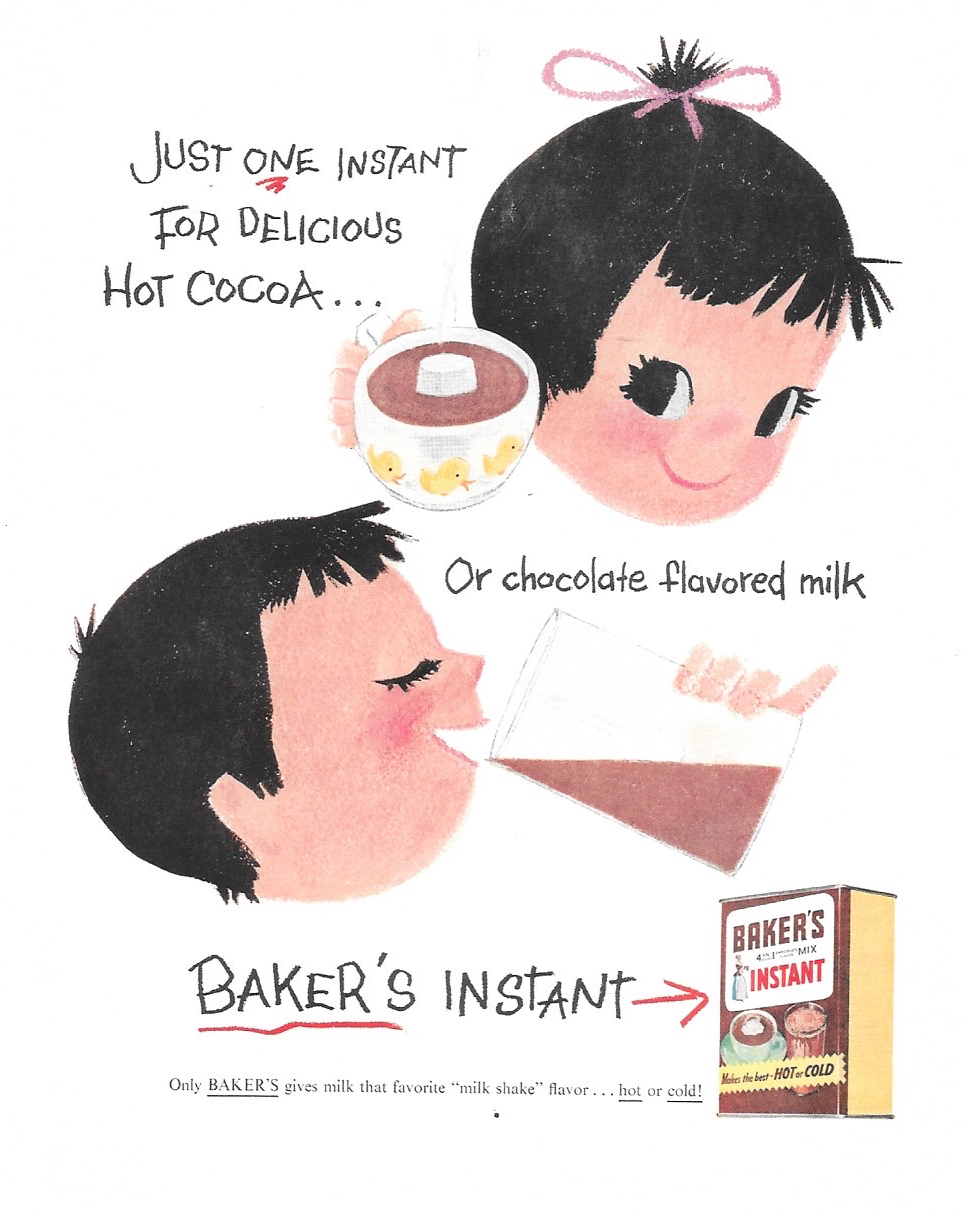
Baker’s Instant Cocoa -Hot or Cold!

Vintage Advertisement of the Week – August 8, 2024

Absolutely adorable advertisement from 1955/1956. Widely circulated in baking and home and garden magazines.

History highlights: Baker’s Cocoa.

Baker’s Cocoa was started back in the 1760’s by two likeminded people named, John Hannon and Dr. James Baker in Dorchester, MA. Hannon was an Irish immigrant and businessman who sourced the cocoa, Baker was a Harvard graduate who used his money to back Hannon and his chocolate aspirations. It was originally called Hannon’s Best Chocolate. Hannon mysteriously disappeared while on a sourcing expedition in the West Indies in 1779. Sounds like the makings of a novel in the works. What really happened to Hannon? Did he die, did he disappear of his own volition? Maybe he was drawn to the West Indies and wanted to go off the 1770’s grid and live his life in the 18th Century tropic wilds. We shall never know. What we do know is his wife had no dreams of continuing the cocoa business. Washing her hands of the entire matter, his widow sold her stake in the company to Baker in 1780. Enter: the Baker Chocolate Company!1

Baker Chocolate Company is known for more products than the bitter baking chocolate bar you mistakingly took a big bite of out of your mom’s cupboard when you were 8 years old and thought all chocolate tasted like a Hershey’s bar. They carry a full line of chocolates, from semi-sweet, to white to 100 % cocoa to dipping chocolates (milk or dark).

Do you have any neat memories about baking with Baker’s Chocolate with your family? Feel free to share.

That cute ad art makes me want to whip up a cup of hot cocoa today!

  1. White, Anna. “Dorchester History Lesson: Baker Chocolate Factory.” Caught In Dot, 11 June 2022, caughtindot.com/dorchester-history-lesson-baker-chocolate-factory/.  ↩︎
Uncategorized

Plath’s Use of Thematic Description

While reading The Bell Jar this time around, I noticed the first three chapters have descriptive themes.

  • Chapter 1 – Attire
  • Chapter 2 – Surroundings
  • Chapter 3 – Gastronomy

In Chapter 1 we get no further than Page 2 before Plath sets her sights on apparel. It is a well known fact, Sylvia Plath was obsessed with clothes and envied the rich girls at Smith. Girls who didn’t have to worry about maintaining their scholarships, because their parents paid for their schooling out of very deep pockets. Plath came from a lower-middle class family and had to take jobs during the summer. She saved money for college and clothes by nannying for the wealthy Mayo family, working in a field as a farmhand and waitressing during summers.

I counted no fewer than twelve instances in Chapter 1 alone where Plath details apparel to illustrate Esther’s opinion about herself or people around her.

Chapter 1 – Apparel

“…uncomfortable, expensive clothes, hanging limp as fish in my closet.” Page 2

“…tripping around in those same size seven patent leather shoes…black patent leather belt, black patent leather pocket book.” Page 2

“…skimpy, imitation silver-lamé bodice stuck to a big fat cloud of white tulle…” Page 2

“…posh secretarial schools like Katy Gibbs, where they had to wear hats, stockings and gloves to class…” Page 4

“…all the girls had pocketbook covers made out of the same material as their dresses, so each time they changed their clothes they had a matching pocketbook.” Page 5

“Doreen lounged on my bed in a peach silk dressing gown…” Page 5

“-the rest of us had starched cotton summer nighties and quilted housecoats, or maybe terry-cloth robes that doubled as beachcoats, but Doreen wore these full length nylon and lace jobs you could half see through and dressing gowns the color of skin, that stuck to her by some kind of electricity.” Page 5

“She (Doreen) was wearing a strapless white lace dress zipped up over a snug corset affair…” Page 7

“I wore a black shantung sheath that cost me forty dollars ($470 US dollars in 2024!)…the dress was cut so queerly I couldn’t wear any sort of bra under it…” Page 7

The New York Public Library Digital Collections. 1957. https://digitalcollections.nypl.org/items/04b53740-a8c2-0132-5c95-58d385a7bbd0

“When a man in a blue lumber shirt and black chinos and tooled leather cowboy boots started to stroll over…” Page 8

“…white lace pocketbook cover.” Page 8

“The thought of dancing with that little runt in his orange suede elevator shoes and mingy t-shirt and droopy blue sports coat made me laugh. If there’s anything I look down on, it’s a man in a blue outfit. Black or gray, or brown even. Blue just makes me laugh.” Pages 11-12

I won’t note each and every instance or Chapters 2 and 3, as reading list borders on tedium. Rather, I will simply note some of my favorites.

In chapter 2 surroundings become instrumental. Esther’s self-proclaimed alter ego, “Elly Higgenbottom”, is intrigued by Lenny’s pine paneled apartment with dead animal artifacts scattered or hung everywhere. I found it interesting that Esther tells us her drink becomes more depressing with each sip. She refers to it as “dead water”. More likely her situation around her becomes more depressing with each passing minute. One has to wonder if her drink takes on the presence of the dead animal heads and skins surrounding her, as she shrinks into the background.

Doreen’s smoke lingers in her room back at the Amazon, making her feel furious and frustrated upon her return.

The china white telephone, normally a lifeline, sat still and “dumb as death’s head”.

Her only saving grace in the entire chapter is a hot bath. She considers each and every bathroom she has bathed in during her life, and in great detail. The pink marble, griffin legged tubs, and coffin shaped tubs all spring to her mind. I find it interesting she recalls one tub as being “coffin” shaped. I had to look it up. This is a way to describe your standard single person fiberglass tub. Nevertheless, again with the reference to death.

She ends the chapter by describing the green hall carpet covered in Doreen’s jet of brown vomit, while Doreen’s blonde hair dabble into the vomit like “tree roots in a bog.” I just love that line.

Chapter 3

Photo Credit: Irenna at : https://pixabay.com/photos/black-caviar-caviar-fish-roe-7274201/

All about food…Plath is obsessed with food. Her journals and letters are littered with accounts of what she ate while at camp, on vacation, at school and just on the normal day to day. So it’s no surprise Plath makes Esther keenly aware of food. But not just any food. Food at the Ladies’ Day luncheon.

Yellow-green avocado pear halves, stuffed with crabmeat and mayonnaise, black gleaming caviar heaped in cut glass bowls1, and mountains of marzipan fruits are juxtaposed against memories of a blue collar burger, fries and vanilla frappes eaten at the hometown Howard Johnson’s (think Denny’s of today). She tells us about the guilt her grandmother doled out while eating supper. Making sure they all knew just how expensive each bite of meat cost.

Esther informs the reader she can eat whatever she wants and never gain a pound. (Plath often said that about herself. Don’t we all wish?) Dishes laden with sour cream, butter and cheese being her favorites.

This chapter is a particularly amusing one to me. Especially in the way she highlights the others sitting around the table, like they were all just taking up space (sad replacements for her wild and exciting friend, Doreen), as well as the way she introduces us to her boss, Jay Cee. More about those around her in another post when we touch on Esther’s depression and narcissistic tendencies as Plath highlights them through secondary characters.

One last note on food. My favorite part of Plath’s inclusion of food in Chapter 3 is when Esther is silently crying and eating her meringue and brandy ice cream. Not because it is funny, but because it’s relatable. She eats her own ice cream then absentmindedly makes swift work on Betsy’s proffered bowl. I think we have all been there. Eating mindlessly as we work through our worries.

  1. Does this make anyone else think of F. Scott Fitzgerald’s Story The Cut Glass Bowl, first published in Scribner’s Magazine in May of 1920? https://americanliterature.com/author/f-scott-fitzgerald/short-story/the-cut-glass-bowl/#google_vignette ↩︎

I would love to hear your favorite parts of Chapters 1-3. Did you have a favorite description?

Vintage Ads

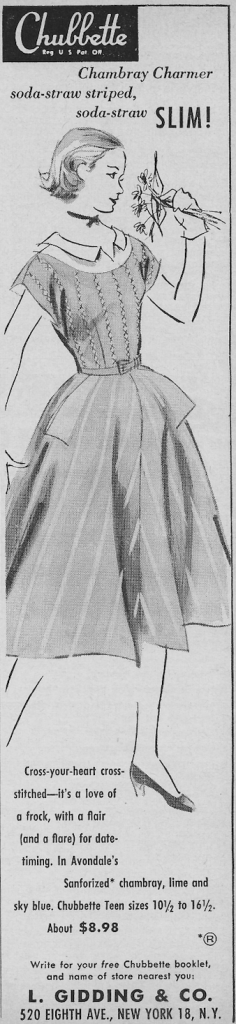
Chubbette!

Vintage Advertisement of the Week – July 31, 2024

From Senior Prom: the GIRLS’ Fun, Fashion & Fiction Magazine, March 1951 Issue

Oh my stars and garters! The horrors of having to get your back to school clothes from a brand called “Chubbette”?! That’s even worse than having to shop in the husky section at Farm and Fleet. I think I’m still traumatized. Sending loving vibes to all those who may have been coerced into thinking wearing a brand like Chubbette was the “in-thing” and was going to solve all if any of life’s problems. Let me tell you, the husky jeans did nothing for me!

Uncategorized

There Will Come Soft Rains – Sara Teasdale

(War Time)

There will come soft rains and the smell of the ground,
And swallows circling with their shimmering sound;

And frogs in the pools singing at night,
And wild plum trees in tremulous white,

Robins will wear their feathery fire
Whistling their whims on a low fence-wire;

And not one will know of the war, not one
Will care at last when it is done.

Not one would mind, neither bird nor tree
If mankind perished utterly;

And Spring herself, when she woke at dawn,
Would scarcely know that we were gone.

Originally published in Harper’s Magazine, July 1918

Uncategorized

The Rosenbergs, Executions, and Foreshadowing

https://www.theguardian.com (Picture Credit)

“It was a queer, sultry summer, the summer they electrocuted the Rosenbergs, and I didn’t know what I was doing in New York. I’m stupid about executions.”

Just like that, bang! Can we take a second to appreciate the emotion that weights down those two simple, yet well crafted sentences?

It took my second time of consuming this book (I’ve read it two times and listened to the audiobook twice) to understand why Plath started her novel off with these sentences. Of course, hindsight is 20/20. Why talk about the Rosenbergs being executed? What does it have to do with the main character’s situation as it stands in New York during 1953? To date the novel? Perhaps. Yet, why employ executions as the bridge for the narrator to question why she is in New York? Even before the end of the first sentence, we know she is discontent. Instead of being excited she won the privledge to work at a prestigious magazine, she’s wondering why she was even there. She goes on to say at the end of that same paragraph, “It had nothing to do with me, but I couldn’t help wondering what it would be like, being burned alive all along your nerves.” Foreshadowing? Maybe. Most likely. What do you think?

No matter how you dice it, that first paragraph paints a picture of gloom and despair.

Later she goes on to say, “I knew something was wrong with me that summer, because all I could think about was the Rosenbergs, and how stupid I’d been to buy all those uncomfortable, expensive clothes hanging limp as fish in my closet…” The narrator is having an obvious preoccupation with death. The clothes hanging like a string of dead fish on a line serves to add to the imagery.

Another obvious note of discontent comes to us as early as page two. “And when my picture came out in the magazine the twelve of us were working on…everybody would think I must be having a real whirl.” It is obvious she was not having a whirl. She goes on to express, “only I wasn’t steering anything, not even myself.” She is empty and rudderless.

Heavy, powerful stuff to start a novel off with, and we haven’t even made it to page 3.

What did you notice in these opening pages? What mood do you feel Plath was trying to infuse into the reader? Did her opening grab you, or did it take a while for you to feel engaged with the narrator?

If this is a revisit reading this novel, do you recall where you were when you read the opening pages for the first time? I can. I was at the corner down from my house heading south, walking my dog. I was listening to Maggie Gyllenhaal’s narration of the audio book. Just an aside – if you haven’t listened to this version, I cannot recommend it enough. Gyllenhaal’s wry delivery is unparalleled. It was so powerful, I can scarcely read the words on my pages without hearing Gyllenhaal’s voice. As I reread this book have to train my brain to use its own imagination to craft my own voices for Plath’s characters. If you know of a better audio book version please let me know. I welcome hearing other approaches.

The first few pages set the stage for what feels could be a heavy, humorless tome. Yet, somehow, Plath proves this assumption incorrect. Her humor quickly shows in the first chapter as she expands her cast of characters.

Next up, Doreen, Betsy, Lenny Shepherd, and Frankie.

Uncategorized

Best Novels of the 20th Century?

“Best” is such a subjective word. A theme may resonant firmly with Mrs. X, while not at all with Mr. Z. If a theme leaves us feeling listless or without spark, we may rely on a character to pull us through. Yet, we must be able to connect to a character in order to feel invested in them. Without investment our interest often wanes and dies. Our only hope to enjoying a book without a character or plot connection is if an author’s writing is so strong, unique, or pointedly beautiful that we can forgo all else.

We’ve all been burned by and had DNF (Did Not Finish) experiences with books. I can think of more books than I have fingers and toes that I struggled to get through. But what of those books that we flew through and knew we would read again and again? The ones who writing made us sit and think for days? Whose writing left us feeling as if we were in a spell? The ones we keep on our physical book shelves, because they are too precious to donate to the local thrift store or little library? These well loved favorites that we treasure like the air we breathe? The ones where we felt the writer nailed something on the head like no-one before or after ever will?

Instead of listing what I feel may be the “best” novels of the 20th century, I will share my favorites. They are, not in any order:

  • The Bell Jar – Sylvia Plath
  • Catcher in the Rye – J.D. Salinger
  • The Great Gatsby – F. Scott Fitzgerald
  • Charlotte’s Web – E.B. White

All four have one similarity that weave in and out of their work. The obvious theme of being young and discontent. This feeling of wanting more in life than what we have at present is what makes us want to lie down and quit, but also drives us to achieve more. Haven’t we all felt like this at some point in our lives?

I plan to revisit each novel, in turn between now and September of 2025. I urge you to join me. Join the journey. Join the discussion. None are lengthy, and most are quick reads. I’ll start with The Bell Jar by Sylvia Plath. If you haven’t read this book, I highly recommend it. It has so many passages that will make you sit up and think or lose sleep. People marvel at Plath’s turn of phrase in her poetry, which was without a doubt unparalleled, but what she accomplished with The Bell Jar is absolutely amazing in its own right.

I welcome comments from you as we read these together. What hits home? Have you ever felt like the Esther? Is there anything you feel detracts from the flow of Plath’s novel? Feel free to post your favorite quotes or passages from the book as we read The Bell Jar.

I encourage you to share your favorite books of the 20th century. Your list and comments are appreciated below. Let’s have a free, open and respectful discussion about our favorite books.