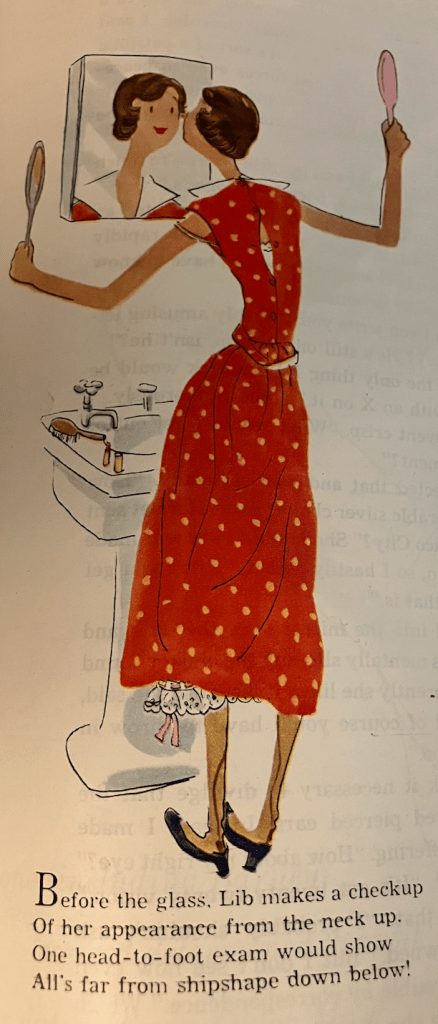
Illustration and Verse 3/6

Author, Literary Buff, Baker, Knitter, Old Time Radio Dabbler, Historical Commentator of All Things From Mid-Century Americana

Illustration and Verse 3/6
From the June 1950 – Seventeen Magazine “How to Be Pretty Issue”
Drawings by Annabel Hagyard – Verses by Barbara Moench
Every month, during the late 1940s and early 1950s Seventeen Magazine put out a cute two page spread focusing on a theme. The intent was to teach proper femnine etiquette through adorable persuasion.
Barbara was an assistant literary editor for Seventeen. I’ve yet to find much on Annabel Hagyard, except for a reference to a publication titled, “Art Directors Annual of Advertising” from 1948.
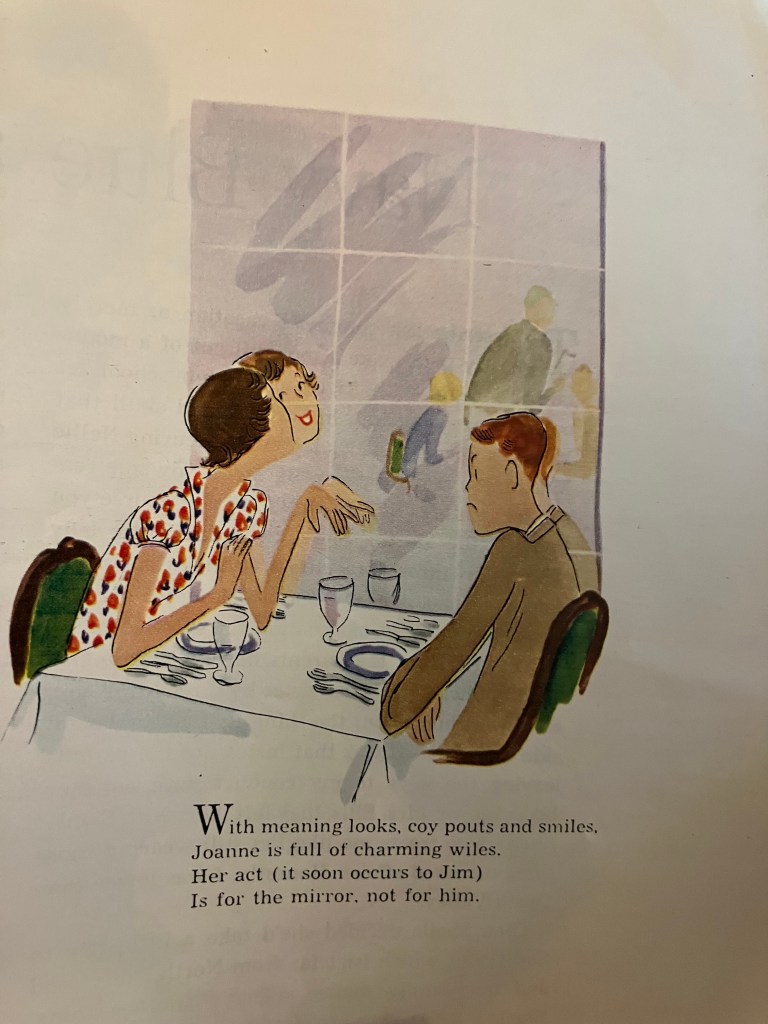
June 1950’s theme was vanity. I plan to post a picture a day from this spread, just for a fun visual coffee break. There are six pictures with accompanying verses in all on vanity.
Cartoon art is so incredibly mid-century Americana and such a joy to look at.
Mirror Mirror on the Wall Picture 1/6


Mirror Mirror on the Wall Picture 2/6
Vintage Advertisement of the Week – September 5, 2024
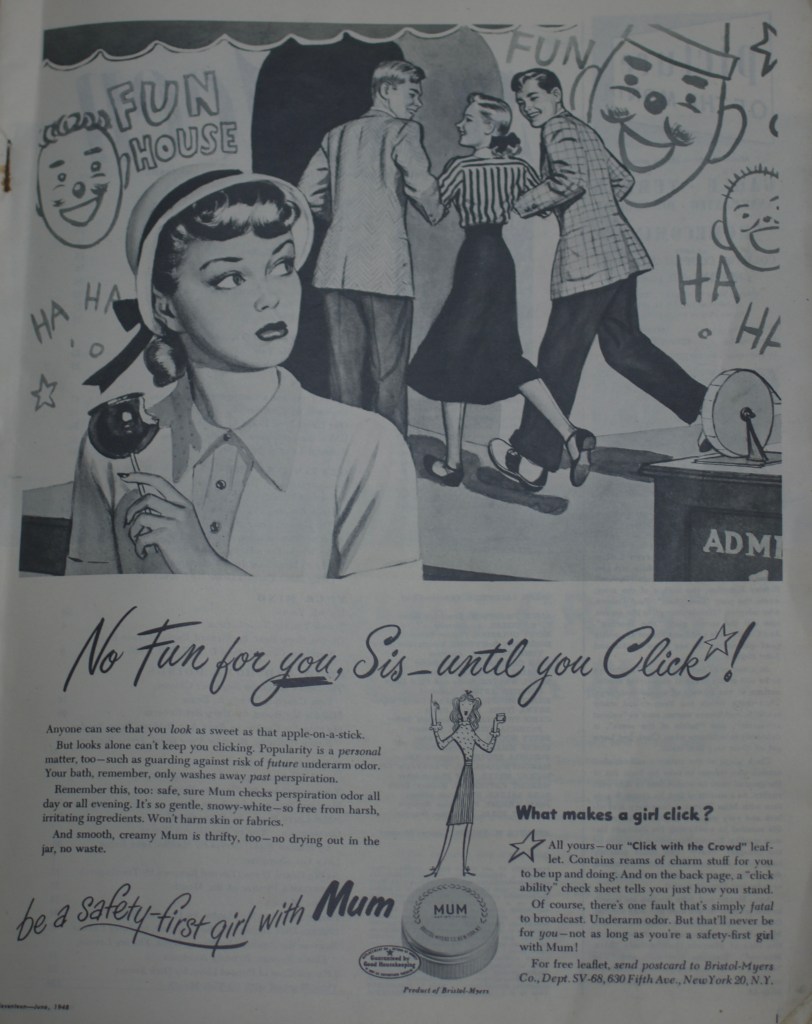
Seventeen Magazine – June 1948
Where to begin? This ad has so many highlights, but just as many low.
Can we start with the blatant message of peer pressure to conform and belong? I am sure this message resonated with each of us at some point in our lives. Now don’t get me wrong. I’m not suggesting we all abandon good hygiene, and walk around stinking, just to be a nonconformist, but this ad hits a girl straight in the eye. Use Mum and you could be like the smart, fresh girl being escorted into the fun house with not one, but two, clean cut young men. Forgo using Mum or use an inferior product and you will be stuck with a pathetic, partially eaten candied apple on a stick as your partner.
Yet, this illustration is cracker! It’s cute, catchy and carnival. Everyone looks so nicely dressed. Neat as a pin. The girl smiling up at the collegiate something in the tweed sports coat, looking carefree and gay, while the other young gentlemen looks back in his plaid jacket at the girl abandoned at the ticket counter with an amused look on his face. Smiling, all three entering the fun house are nothing but smiles. Could that smile on the plaid jacketed young man be an inviting smile? Use Mum and you could be part of our gang? Or, is it a pitiful joking smile that says, “Girl, get with it – straighten up and fly right. You smell, ya’ dope!” Everyone is so clean, clean, clean! Except for the worrisome looking girl in the hat with the candied apple, of course. Either way, Mum wins.
The tag line at the bottom is too funny. “Be a safety first girl with Mum.” Listen to Mum, she knows what’s good for you. Yes, use Mum so you too can be taken into the dark fun house with two college aged boys, who just want to laugh at the fun house mirrors and do pretend jump scares at the creepy clowns. Sure.
The tone in the ad is all about “clicking” with your peers. You can’t click if you don’t use Mum. A play on the word “clique”, but enough so it gives you pause. I want to be part of the click or clique, whatever they’re talking about, I want in. My inner teenager agrees, my adult self scoffs and says I am just fine with my tried and true Secret anti-perspirant/deodorant, thank you very much.
Nevertheless, I have seen many ads in old magazines for Mum. This particular sales ad says it earned the Guarantee of Good Housekeeping, a warranty seal that still exists today. Not satisfied with a product with the Good Housekeeping seal of approval? No worries, you can get a replacement.1
You can even get extra special advice on how to earn others’ respect and see you in a better light, if you write away to the address in the lower right hand corner of the advertisement. I found an old copy of an advertising pamphlet called, “As Others See You”, put out by Bristol Myers, Co. I’m guessing it’s the precursor to their “Click with the Crowd”. American ad agencies regularly regurgitated material. I will offer up tidbits of their advice throughout the year. Coming soon to a blog near you.
A short history of Mum:

Love this ad from the 1960s. Source unknown.
Just sampling of the products Mum carried over the years:
Mum really is the word.
Sylvia Plath – November 4, 1962
(HarperPerennial Modern Classics)
The word of a snail on the plate of a leaf?
It is not mine. Do not accept it.
Acetic acid in a sealed tin?
Do not accept it. It is not genuine.
A ring of gold with the sun in it?
Lies. Lies and a grief.
Frost on a leaf, the immaculate
Cauldron talking and crackling
All to itself on the top of each
Of nine black Alps.
A disturbance in mirrors,
The sea shattering its grey one —
Love, love my season.
Vintage Advertisement of the Week – August 29, 2024

Christmas in July: Cologne, Cologne Spray Mist and Dusting Powder (Seventeen Magazine, July 1960). (Cologne, Mist and Dusting Powder by Monico Inc. New York a subsidiary of Bourjois of an Evening in Paris fame.)
Can’t you just imagine the ad campaign board room when this beauty was proposed? A bunch of suits sitting around with a bottle of green perfume perplexed. How the heck they are going to promote it? Who will buy it? Mature ladies already love an Evening in Paris and Chanel No 5. They know the market for teen scents can be expanded, but how? Let’s listen in…
“Hey, Mike, what the hella’ we gonna do with this?” Sam asks passing the bottle over.
“Beat’s me, Sam.” Mike scoffs tossing it to Don.
Don takes a drag on his Winston cigarette, turning the bottle over in his meaty hand. Ash falls absentmindely onto the oak table they are sitting around. Don ignores the ash as he robotically places the bottle in front of him, taking another drag on his smoke. Then placing his cigarette in the company ashtray in front of him, he uncaps the bottle and sprays some perfume onto his business card. Don takes a whiff and passes over to the other men. They each inhale the floral array in turn. Sam sets the card before him and tents his fingers together in thought.
“Christmas in July,” Sam mutterers. “What the hell was Monico thinking?”
A heavy silence falls on the group.
Finger snap, “I’ve got it!” Don exclaims all abuzz. “Let’s build off the green theme of Christmas and the cologne. We’ll capture a young 16-something, sexy bathing beauty type swimming in the ocean.”
“Like a mermaid?” Mike asks.
“Yeah,” Don agrees. “Only without the tail. That tail would cover too much. That’s no good. Got to show off her gams, in a skimpy, skin tight suit. One of those nylon jobs.”
“Green suit?” Mike proposes.
“What else?” Don says. “But the same green as the water, so it looks like she’s barely wearing anything at all.”
Sam taps his pen on the board room table in consideration. “It’s good, but it could be better.”
“How so?” Mike asks.
“What if, we have her swimming toward the bottle of cologne?” Sam proposes, finally adding substance to the conversation, earning his paycheck for the day.
“Words. Give me words, boys,” Don asks.
The trio starts brainstorming off one another, “merry, holiday, green, cool, balmy, ocean,” are all tossed about. Suddenly, Mike smacks his open palm on the oak table. He’s going to knock it out of the park.
“Wait! I’ve got it,” he exclaims excitedly, “she isn’t swimming toward the bottle she’s swimming toward a tree. A fully trimmed Christmas tree at the bottom of the ocean!”
“Brillant!” Sam and Don agree, pleased with how smart, hip and fresh they are. Any yutz could have thought of the bottle, but a fully trimmed Christmas tree, that’s gold. They know this younger generation better than they know themselves. They know what they need to feel appealing to the opposite sex. To feel attractive and wanted. Christmas in July, that’s what they need.
All three sit back in their swivel chairs, throughly convinced they are onto something big. They caught the next big wave in marketing – underwater campaigns. They are going places.
While reading The Bell Jar this time, I wondered, did Plath write about her food poisoning incident and follow it up with our in depth introduction to Buddy Willard with intention? Without a doubt, the guest editors’ bouts with ptomaine poisoning leaves an impression and makes the reader think twice about wanting to eat crabmeat and mayonnaise anytime soon. Plath wrote the scene so vividly, you can practically hear the retching in your head and smell the vileness that must have permeated the halls and bathrooms of the hotel/apartment from the women that fell ill.
I found it interesting it took what must have felt like a near death experience for Esther to realize she wasn’t going to hang out with Betsy’s crowd. That, deep down, she really was drawn to Doreen and needed Doreen’s influence in her life. Esther is an interesting character. Very much like Plath, relatable, yet not always the nicest person. Which brings us to her portrayal of Buddy Willard.
Poor Buddy Willard. I say “poor Buddy Willard” a little tongue in cheek. Plath writes Willard as if she has a major axe to grind. He is a pompous person. Any female can appreciate the scene where Mrs. Tomolillo is giving birth. She is obviously in tremendous pain, but Buddy assures Esther the birthing woman is in a “twilight sleep” from the drug they gave her. Esther knows that’s a load of bull, pointing out Mrs. Tomolillio wouldn’t be groaning if she weren’t in pain. We’ve all known someone like Buddy. The type of person who offers their self-proclaimed expert opinion, even when not asked. A person you just can’t help wanting to knock down a peg.
We know from Plath’s journals, Buddy Willard was modeled after her old boyfriend, Dick Norton. For his part, Norton, stayed mostly silent about his time with Plath. Whether he valued and respected their relationship that much or simply did not feel the need to defend himself, we may never know. They had quite a history, growing up, their mothers were fast friends. Dick’s brother, Perry Norton, was very close with Plath and in many ways a better friend. But, Dick, had been so revered by Plath. Heather Clark writes, “Dick was Sylvia’s ideal: blond, blue eyed athletic, intelligent ambitious and a family friend.”1 One has to wonder if Plath didn’t place her frustration with the double standard of the time squarely on Dick Norton’s (Buddy Willard’s) shoulders.2 Males were allowed to have sex before marriage and people looked the other way. Females were supposed to stay true and pure until that ring was on their finger. Plath never appreciated being told she could or could not do something, especially if it was a double standard between the sexes.

Sylvia Plath and Dick Norton at the Yale Junior Prom, March 9, 1951 (Photo Inserts from “Red Comet: The Short Life and Blazing Art of Sylvia Plath, by Heather Clark)
So it comes as no surprise that Esther, tough as nails on the outside, cool as a cucumber, and sensible as a New England girl could be, would show no outward emotion at having witnessed cadavers being sliced open, stillborn or aborted babies floating in bottles of formaldehyde for educational purposes, and a live birth. Buddy didn’t blanche at such things, so neither would she.
It’s the hypocrisy of Buddy Willard that breaks her. The fact that she finds out he is not a virgin. Not just that he is not a virgin, but that he slept with “some slutty waitress one summer” named Gladys upwards of 30 times in a single summer season. She is not just disgusted by the fact that he is a hypocrite, but that she is not allowed to unleash her sexual frustration given the standards of the times.
We can tell it was the straw the broke the relationship’s back. Esther had already been trying to find ways to cut Buddy down to size. Spending free time thinking up witty comebacks to put in him in his place, after the fact. When he exposes himself to her, she is disappointed in what she sees referring to his male genitalia as “a turkey neck and turkey gizzards”. She then makes up an excuse to not show him her naked body, as a way to get back at him.
The starkest example of her decaying feelings toward Buddy is illustrated when he tells her he has contracted Tuberculosis. She did not feel sorry for him, but rather relieved, possibly vindicated. As if he brought the disease on himself, by his own hypocritical attitudes and tarnished behavior. Esther has valid human feelings to be sure, but they are complicated.
Humans, even fictional ones, are complex beings. That’s what draws us in, what keeps us engaged. I can’t say we haven’t all met someone we once felt was the most exciting person ever, only to realize we had a lapse in judgment. We can relate to Esther’s evolution of feelings toward Buddy, but that doesn’t mean we have to whole heartedly support it. Instead of saying she would write to him up at the TB colony in the Adirondacks, she should have just cut the relationship off and been done with it then and there for both their sakes. Maybe given the family dynamics that seemed like an impossible thing to do.
Nevertheless, Esther’s choices and attitudes come into question more and more. From food poisoning to poisoning of the spirit. Esther’s state of affairs keeps decaying further. We know it is only going to get worse.
Langston Hughes (1951 – New York : Holt)
What happens to a dream deferred?
Does it dry up
like a raisin in the sun?
Or fester like a sore—
And then run?
Does it stink like rotten meat?
Or crust and sugar over—
like a syrupy sweet?
Maybe it just sags
like a heavy load.
Or does it explode?
Vintage Advertisement of the Week – August 22, 2024
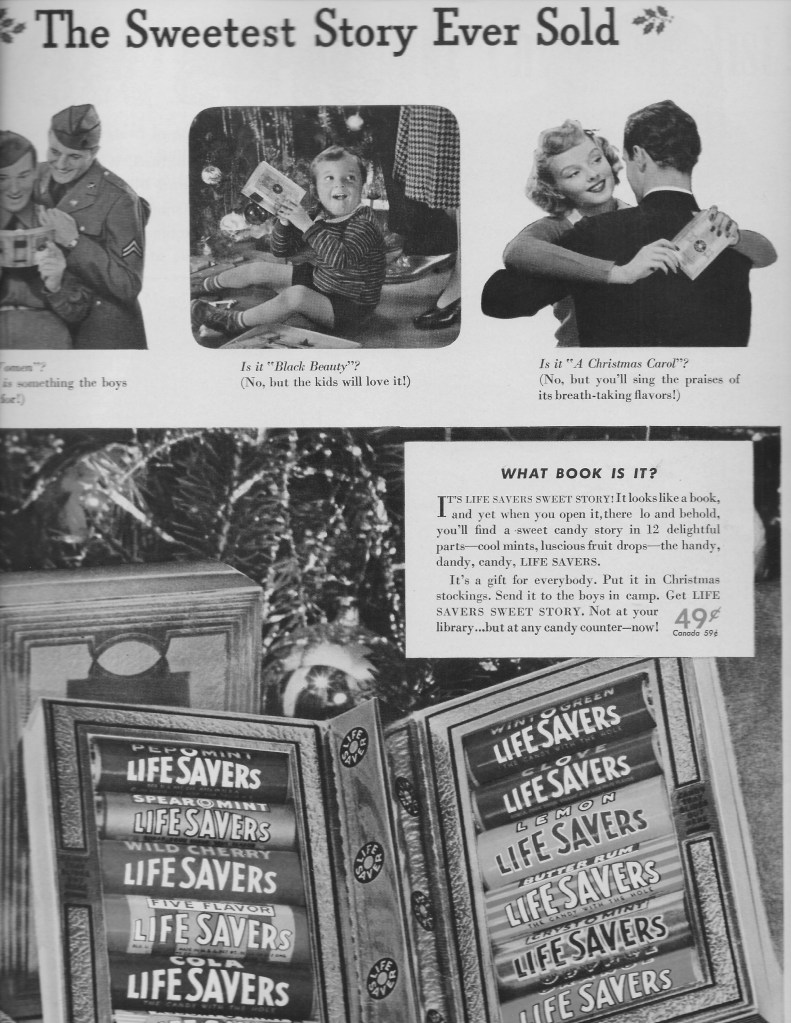
Any kid who grew up in the United States and Canada remembers these treats. The Life Saver Christmas Story Books were an affordable gift to give your friends when you had mere coins to spend on Christmas gifts in the school days of our youth.
This particular advertisement comes from Life magazine’s, December 15, 1941 issue. The candy box contained 12 classic flavors, some now lost to history:
A Brief History of the Company
Clarence Crane of Cleveland, Ohio, invented Life Savers in 1912 as a summer candy alternative to chocolate. The first flavor was Pep O Mint. They were made with a special punch by a pill manufacturer. The hole in the middle gave the hard candy the look of a life preserver, hence the name Life Saver was born.1
After registering his trademark in 1912, Crane sold the company and the rights to the name to Edward Noble in 1913 for $2,900,2 equivalent to $92,137.90 in 2024 dollars. Life Savers would change hands in the centuries to come several times. Here is a brief outline of how often the company changed ownership:
Manufacturing Tidbits
The candies used to be wrapped in tin foil to keep them fresh. This was done entirely by hand, until Noble’s brother Robert Peckham Noble, an engineer, designed a machine that streamlined the process. Robert Noble became the company’s CEO for the next 40 years.3
Interesting flavors, now defunct are: Lic O rice, Cin O mon, Vi O let, Choc O let, Hot Cin O mon, Sweet Orange, Sweet Mint and last, but not least, Malt O Milk. Apparently the Malt O Milk (1920) variety was not well received.4 I wish they would bring it back. I would love to try it.
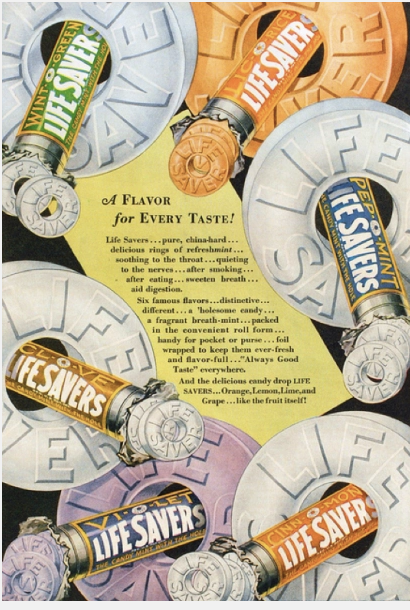
Life Savers Ad; from the 1930’s.
Prices sure have gone up for this holiday treat. In 1941, the Christmas Storybook cost just .49¢ ($10.48 in 2024’s dollars). Walmart is currently selling the gift for $14.59. 5 I suspect this price will drop as the holidays near.
There is a ton of information out there on Life Savers. So many interesting ad campaigns exist for this company throughout the decades. I’ll be sure to post more in the future.
Nearly everyone has a favorite Life Saver memory or flavor. What’s yours? My favorite flavor is Butter Rum. Now if they could only bring back Vi O Let and Malt O Milk. Maybe they would give Butter Rum a run for its money.
Vintage Advertisement of the Week – August 14, 2024
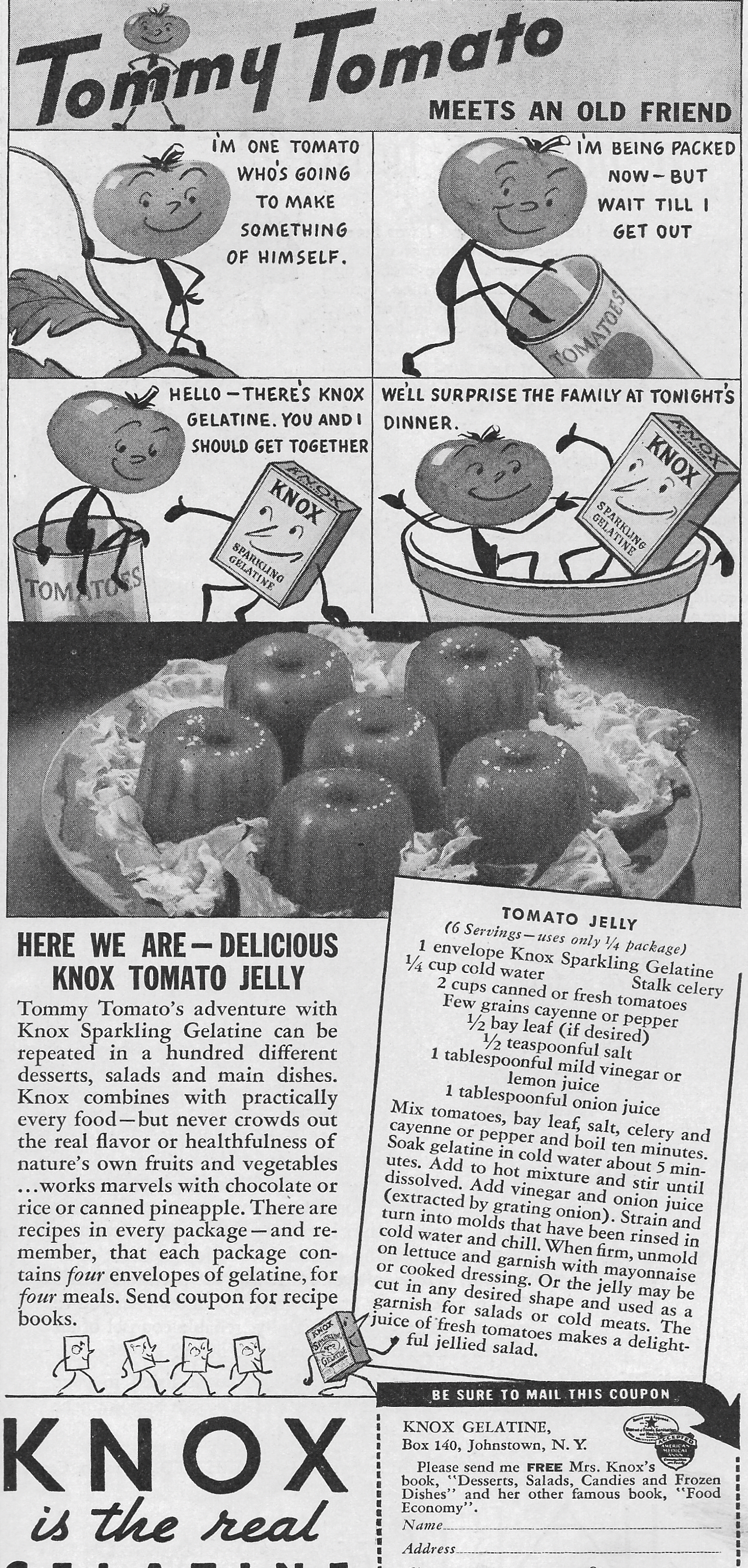
By far not the grossest thing I’ve seen in the world of the frugal 1930’s, but still looks quite unappetizing to me. Gelatin dishes from the 1910’s to the 1970’s were a bizarre island unto themselves. I could spend years discussing American food advertisers’ obsession with pushing these odd cost savings concoctions on the consumer. In my book, these tomato gelatin rings get a 5/10 on the gastronomically noxious scale. Noxious – Knox, get it? 5/10, that high of a rating you say? Oh, it gets far worse.
A brief history of gelatin – This particular recipe falls under both gelatin camps; what the average American thinks of when they hear “Jell-O” and aspic. Even though Jell-O should be fully accredited to the brand name as it is a trademarked entity, it was so widely popular that when one hears the name mentioned a person can’t help but conjure up visions of the jiggly, brightly colored, fruity gelatin. Knox gelatin can be made into a fruity dessert, by mixing fruit juice or fruit with it. It can be the base for most anything wiggly, derived from things we would rather not think about. Aspic on the other is a whole different bag of tricks. Aspic has its roots in Europe. Nearly every country in Europe has a version of aspic. Essentially, it is meat broth turned into gelatin. It can be a clear meat broth gelatin or it can have edible objects suspended and confined within its glassy walls. Beef, pork, chicken, seafood or vegetables can be mixed with gelatin reminiscent of a stained glass window. It is served cold. That’s how it keeps its shape. Tommy Tomato’s gelatin ring sounds infinitely better to me than meat and vegetable aspic. And, yes, I’ve tried it. It’s a 0/10 rating for pork and peas aspic from me, I’m afraid I’m just not that evolved culinarily speaking.
Merry Memory – Famous Actress Goes Postal Over Lack of Aspic – During the first half of the 20th century, wealthy families would order special versions of aspic, that could often be molded into statuesque “art” for show. These were often not even deemed edible, but served as more centerpieces. Billie Burke delivers a famous speech from “Dinner at Eight” that mentions aspic.1. Just try not to conjure up Glinda the Witch of the North if you can. It’s so hard to separate that gay, lilting voice from her iconic role. I do love Billie Burke in “Dinner at Eight”. It’s a great film and has a wonderful all around cast (including both Lionel and John Barrymore).
Now back to America’s obsession with gelatin…
For our argument, the marriage of Tommy the Tomato and Knox Gelatin could fall into either the sweet side of gelatin, or the savory aspic camp. It is really up to how you classify tomatoes. It’s the age old debate, is a tomato a fruit or a vegetable?
Condensed History of Knox Gelatin – One more thing, you can see that the reader of this Good Housekeeping magazine can inquire for more recipes by writing to Mrs. Knox at P.O. Box 140, Johnstown, NY. There really was a Mrs. Knox, her name was Rose Knox. She started the Knox Gelatine Company with her husband Charles back in 1890. When Charles died unexpectedly in 1908, she took the company over. Unlike Mrs. Hannon of the Hannon Chocolate Company, she had a head for business. She made the shrewd business move to target women with their product, as she knew women did the grocery shopping. She was a progressive woman. She insisted all workers were valuable and they come to work and walk through the front door (before then some workers were only permitted to enter and exit through the back door). Furthermore, In 1913, she instituted the five-day work week, gave two weeks of paid vacation for all, as well as offered sick leave. Quite unheard of for that time.2
For you doubter’s about just how gross gelatin combinations of the 20th century evolved, tune in for more strange gems of our great recipe book of Americana in the weeks and months to come.
I have eaten
the plums
that were in
the icebox
and which
you were probably
saving
for breakfast
Forgive me
they were delicious
so sweet
and so cold
Williams, William Carlos. “This Is Just to Say by William Carlos Williams.” Poetry Foundation, 15 June 2020, http://www.poetryfoundation.org/poems/56159/this-is-just-to-say.
 Tidbits and Timemachines