Apologies for being MIA for months and months. I promise, I will be back in the near future to finish revisiting The Bell Jar with you and hopefully moving on to another great novel. In the meantime, I wanted to post a quick, fun, yet useful, tidbit.
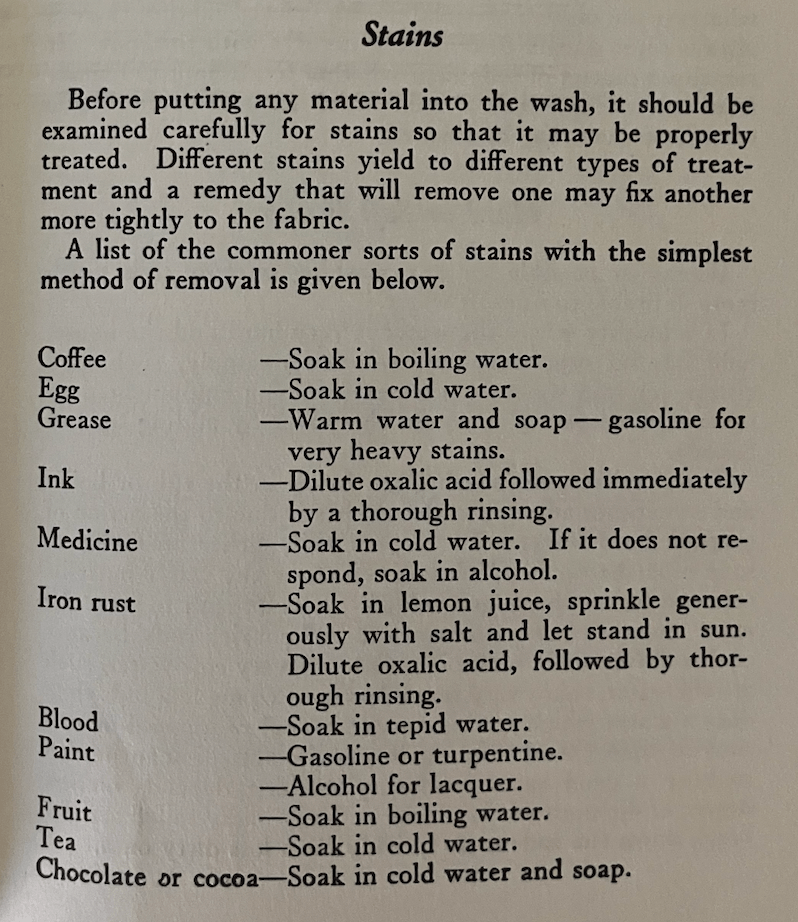
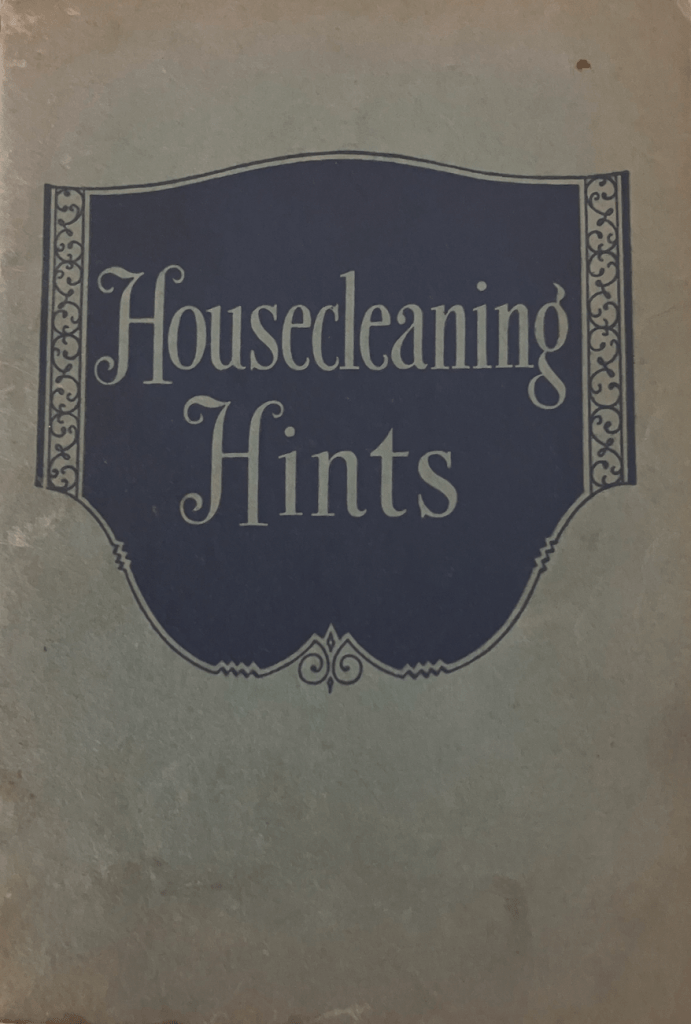
Have you ever gotten a stain on your shirt and thought, well now, how on earth am I going go get that out? Well, look no further. I have been there. While walking my dog today, I tried to do a good deed. I picked up a McDonald’s wrapper that was lying in our neighborhood park parking lot to throw away. Unbeknownst to me, the wrapper had a package of honey dipping sauce with it. I ended up slopping honey all over one of the gloves I was wearing. As soon as I got back home, I grabbed a handy little pamphlet I inherited from my Grandma, entitled Housecleaning Hints. It has tons of useful information right at your pre-internet fingertips on how to keep your entire house, including drapes, davenport/sofa fabrics, and apparel clean.
The closest thing to getting honey out on this list is to soak it in boiling water (fruit stains). I used very hot water, and crossed my fingers. For other trouble shooting ideas on stains, give this a gander:
This particular book was put out by Procter & Gamble in 1931. American companies in the early to mid-20th century were known for giving out free publications as a way to corner more of their share of the market. The General Foods Cooperation did it with Jell-O. Calumet and Clabber Girl baking powders had their own free cookbooks. And, have you ever noticed that General Mills always insists you use Gold Medal All-Purpose Flour or Swans Down Cake Flour in every Betty Crocker baking recipe? It’s a not so clever way to make more money.
Procter & Gamble is quite the conglomerate of businesses these days. While items such as Chipso Flakes and Star Washing Powder have long since landed in the graveyard of bygone products, Procter & Gamble’s modern portfolio ranges from Pringles to Mr. Clean to Gain to Tide to Crest toothpaste, not to mention 17 other big names. They really are a force in the American logo landscape.
This episode has some of the best of the cast in the entire radio run of the Jack Benny Show.
Jack Benny – as himself
Eddie Anderson – Rochester
Dennis Day – as himself
Don Wilson – as himself
Mel Blanc – as the painter and train announcer
Frank Nelson – as the Information Desk “Yes” man
Sheldon Leonard – as the Race Track Tout
Artie Auerbach – as Mr. Kitzel
Bob Crosby’s Orchestra
The Jack Benny radio show is considered one of the best comedy shows of Old Time Radio (OTR). Some even say it is the best. It aired from 1932-1955. Jack Benny began his TV show in 1950. Even with the transition to TV, he was a die hard proponent of keeping his radio show going as long as possible. Contrary to the running gag that Jack was cheap, he paid his cast members well. He wanted to support them as long as possible. So for five years, he continued working on the TV show and his weekly radio show concurrently.
This particular episode is a gem. It has many running bits that go back decades in the making. All in all, it’s pretty clean, cute comedy. Many people these days may find the comedy and commercials (Lucky Strikes and Tareyton Filter Cigarettes) to be dated and simple. Today’s world moves fast. Maybe simple is just what we need now and again.
The path to self-destruction grows ever steeper in Chapters 10 and 11. Plath’s use of imagery and word choice becomes increasingly more depressive.
The very first line of Chapter 10 paints a bleak picture. “The face in the mirror looked like a sick Indian.”
We find Esther clinging to the bloodied stripes swiped across her cheek from her sexual assault the previous night. It makes me wonder. Is she holding onto the bloodied evidence because the event gave her a shot of exhilaration? Did it make her feel more alive than when she first arrived in New York? Or, is she choosing to not wash her face, because she doesn’t have the energy to do anything but exist. She clearly does not care what the rest of the passengers think of her appearance. She rationalizes her choice, telling herself others look queerer (stranger) than she does.
As the train rolls on she takes in the suburban surroundings. Saying, “It smelt of lawn sprinklers and station wagons and tennis rackets and dogs and babies. A summer calm laid its soothing hand over everything, like death.”
With each turn of the wheels she gets closer and closer to home. The reader can tell she is not excited to get back home. She didn’t want to stay in New York, but she also doesn’t want to go home. If given the choice to go anywhere at all, I am not sure where she would choose. Nothing seems to please her. Her mother meets her at the station and delivers the final blow during the drive home. Esther didn’t get accepted into the summer writing course she had been banking on. Esther is crushed. The entire rest of her summer had been riding on her taking this course, living at college, and getting out of the suburbs so she doesn’t have to share a house with her mother.
Things only get worse. She finds out Buddy Willard has fallen for a nurse at the TB center. Esther isn’t heartbroken to not be seeing Buddy any longer. Even in the break-up Buddy waffles and tells her they might still work out. It could just be an infatuation he holds for the nurse. He throws her an indecisive bone, telling her she can come visit. Maybe that will allow Buddy to see if he really loves the nurse or is just smitten. At least Esther has the self-respect to tell Buddy where to get off in her response letter.
Thus begins her own waffling. Without the writing course, Esther is rudderless. She has no idea what to do with herself. She considers writing a novel, learning shorthand, becoming a waitress and moving to Germany. Her mind turns toward finishing her thesis. She starts to read the voluminous Finnegan’s Wake, by James Joyce. Attributing meaning to passages, phrases, and gibberish, where there is none to be had. She grows so frustrated with the lack of progress on the Joyce thesis she scraps it altogether. Then she decides she should get out of the honors track and just be a regular English major. But that involves studying 18th century authors, of which she’ll have none of. Even getting her degree at the community college seems like too much of a hassle to her. She has no idea what to do, or to become.
She allows herself to be picked up by some random sailor in Boston. Giving him her pseudonym Ellie Higgenbottom and telling him she hails from Chicago and is 30 years old. She tells him lie after lie, even making up a story about being an orphan. She begins to convince herself she will move to Chicago and become Ellie Higgenbottom. She is lost. She can’t sleep, can’t read, can’t write, and the sleeping pills her family doctor gave her aren’t helping. Esther is referred to Dr. Gordon.
Esther loathes Dr. Gordon from the second she lays on him. She tells the reader, “Doctor Gordon’s features were so perfect he was almost pretty. I hated him the minute I walked in the door.” She finds him to be conceited. In many ways, she sees Dr. Gordon as an extension of Buddy Willard. Perfect features, perfect wife, perfect kids, perfect dog, perfect office, etc. As with Buddy and most men in her life, Esther decides she will play a game with him. She will tell him only what she wants him to know. This way, she doesn’t incriminate herself. She avoids giving too much of herself away. She tries to exert as much control over her situation and herself as she can.
He doesn’t take her seriously. He turns to her and says, “Suppose you try and tell me what you think is wrong.” Leaving her to feel that he doesn’t think there is anything wrong with her at all. He is more interested in what college she attended and flaunting his own merits. He tells her he served as at her college for the WACS before he was shipped overseas during the WWII. He has no problem puffing out his own chest. Much like Buddy. Esther doesn’t trust him, doesn’t like him and doesn’t have faith he can help her in any way. Dr. Gordon is not a good fit for her. We sense his treatment is doomed from the start.
Chapter 11 ends with Esther contemplating how one goes about disemboweling oneself. Not a cheery thought on any level.
Chapter 9 of the Bell Jar finds the protagonist, yet again hyper-focusing on a color. This time, it’s bile green. There’s no attractive way to spin the color bile. The word “bile” evokes the thought of gagging and vomit. It serves as a look back to the ptomaine poisoning incident, but also blankets the reader with a continuing unpleasantness.
Chapter 9 is a difficult chapter to read. From the beginning, we see Esther’s anxiety about the impending Rosenberg execution juxtaposed against Hilda’s enthusiastic attitude for it. Esther recognizes the act of being electrocuted as one of the most inhuman ways to be killed. While Hilda believes it can’t happen fast enough. Once again, the Rosenbergs and their manner of being put to death serves as foreshadowing.
Esther’s inability to do anything plagues her, as illustrated by her catatonic state when presented with packing as well as the mini-breakdown she has during the photo shoot. She can’t decide how to pack her clothes. She can’t decide what prop to use to represent her dream to be a poet. They finally settle on a paper rose from Jay Cee’s hat.
Doreen tries to get Esther to go to a country club dance with her. Esther has her reservations. Not just because she questions the appearance of Peruvian men, but also because of her persistent lethargy. She tells the reader, “It was becoming more and more difficult for me to decide to do anything those last days.” She explains that when she did decide to do something, she would start but then become “utterly perplexed” at how she got there. She only ends up attending the dance, because she can’t deal with the task of packing for home. It is as if Esther is stuck in thick mud. Mud that is turning slowly into quicksand that is bringing her downward, slowly, ever so slowly.
I have to be honest. The scene with Marco has always disturbed and confused me. On the one hand, Esther is blasé about life. She is so blasé, it’s to the point she doesn’t care if Doreen drags her along on another horrible double date. Esther has shown nothing but inactivity in the last few chapters. She acts petrified. She doesn’t know how to move forward. But, with Marco, she behaves contrarily. She nearly accepts his assault. At first we think she is so depressed she is going to allow him to sexually attack her. He calls her a “slut” and tears at her clothes. She thinks, this is it, she is finally going to be raped. But, then something awakens in her. Maybe it is born from a fight or flight reaction. I guess we will never know. Esther fights back. She makes him bleed and hurts him badly enough that he gets off her so she can leave. She even considers retribution by keeping diamond stick pin. She changes her mind at the last minute when her need to get away from Marco overcomes her.
Once again, we see that Esther is drawn to dangerous, selfish, narcissistic people. Marco is a sexual predator, and, Doreen is a loser of a friend, who brings Esther into the situation. Doreen, not only drags her to the gathering, but true to her fashion, abandons her once they get there. Esther must be approaching a new low, or she wouldn’t have still felt the need to find Doreen after all that. As if Doreen would have remedied the situation. Doreen got her into it in the first place.
At the end of the day, it seems Esther is hellbent on suffering. She holds unhealthy relationships. Some people are drawn to the dangerous, the vile or the abusive. Esther must be one of those people.
The chapter ends by Esther returning battered, bruised, and beaten to her last night at the Amazon. She says goodbye to New York by going up to the parapet and dropping her clothing off the edge, one by one, and watches each item as it sails into the inky sky. Each article falls downward, away from her. The clothing representing her experiences in New York. Leading her one more step away from New York and the horrible season she had there. All this is done while wearing only her bathrobe, leaving the reader to wonder just how far she has sunk into depression.
The Barbizon (Inspiration for the Amazon Hotel in The Bell Jar), 140 East 63rd Street, Manhattan, New York – Photo taken on 10/16/2024 by me.
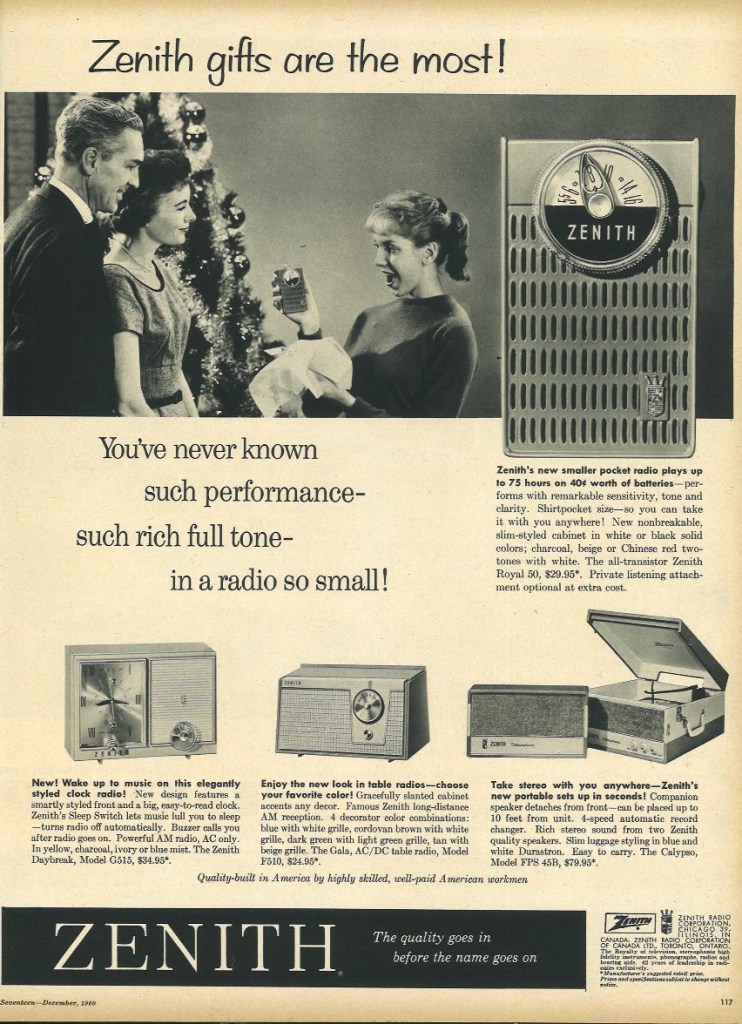
Talk about being the cool kid on the block. Holy cow! Where can I get one of these? Can you imagine waking up on Christmas morning and opening this up in 1960? This handheld transistor radio is the sweetest thing. “Sally’s” parents hit the Christmas jackpot when they picked this out. Now Sally can walk around campus playing all the new tunes. She can stroll the halls, causing a ruckus, and drive her teachers mad with latest rock music. When school is over she can be the kid in the back of the bus that’s got everyone covered with the freshest vibes on the airwaves. Little do Mom and Dad know she will play the radio day and night, driving them up the wall with her rock ‘n’ roll. Because, let’s get real – Sally looks like she is part of the in crowd. No Stravinsky or Rachmaninoff for her. Nothing but Elvis, the Everly Brothers, Bobby Rydell, the Drifters and Sam Cooke will be coming out of that magical rectangular box.
If the iPod was the gift to get in 2001, this was the one to get in 1960. While this is by far not the first portable radio Zenith produced (they were making portable radios as far back as 1924), it is a compact version with high aesthetic appeal. The ad states it plays up to 75 hours on just 40 cents worth of batteries. That’s $4.27 in 2024 dollars. It comes in three color options, charcoal, beige or Chinese red two-tones with white. I live a sheltered life. I had not heard of the color “Chinese red”. The Smithsonian National Museum of Art described Chinese red as, “A vivid orangey-red best described as vermilion. Originally made by grinding the mineral cinnabar and later produced synthetically, vermilion can include a range of warm hues, from bright orange-red to a duller bluish-red.”1 Sounds pretty sweat to me!
Here is a picture of all three Zenith shirt pocket size versions from 19602:
(The Chinese red one is on sale on Ebay for only $29.99-Click here if you are interestedin buying one.)
Zenith was a powerhouse of invention. Check this site out if you want to learn more about the history of the company.
This ad states, “Private listening attachment optional at extra cost.” The Radio Attic has a great picture of the gift set with earbuds:
We’ve come a long way with comfort and technology, but still, there is something ultra sweet about this shirt pocket sized radio. I would have been super stoked, like Sally, too, if I found this under the tree in 1960. Check out the other nifty items shown on this ad. An alarm clock that plays music to wake you up by. Yes, please! That table radio looks perfect for mom, dad or the grandparents. And how about that portable record player with 4 speeds?! That means that little record player could play 45s, 33s, 78s and 16s. It sure is tough to find anything that will play 16 rpm records anymore. Surprisingly, there were some big names that put music out on 16 rpm platforms until the 1970s. The Ventures, Trini Lopez and Jim Reeves to name a few. You could get 90 minutes worth of music onto a 16 2/3 rpm record, because it was so slow.
Back to our shirt pocket sized radio above. Sally is going to be the envy of History class, the gang at the Malt Shop and her after school club. She’ll be tops in her crowd. Everyone will want one!
Zenith gifts are out of this world and really are the most!
Stuart, Jan. “Chinese Red – Smithsonian’s National Museum of Asian Art.” Smithsonian’s National Museum of Asian Art, 2 Sept. 2016, asia-archive.si.edu/red/. ↩︎
Edna St. Vincent Millay – Huntsman, What Quarry? 1939 Harper & Brothers, Publishers
Set the foot down with distrust upon the crust of the world — it is thin Moles are at work beneath us; they have tunneled the sub-soil With separate changers; which at an appointed knock Could be as one, could intersect and interlock. We walk on the skin. Of life. No toil. Of rake or hoe, no lime, no phosphate, no rotation of crops, no irrigation of the land, Will coax the limp and flattened grain to stand On that bad day, or feed to strength the nibbled roots of our nation.
Ease has demoralized us, nearly so; we know Nothing of the rigours of winter; the house has a roof against — the car a top against — the snow. All will be well, we say; it is a habit, like the rising of the sun, For our country to prosper; who can prevail against us? No one. The house has a roof; but the boards of its floor are rotting, and hall upon hall The moles have built their palace beneath us; we have not far to fall.
In the spirit of the nearing the Winter holidays, I am going to switch gears to festive ads. There are so many fantastic ones to choose from. A person could spend two years highlighting them all.
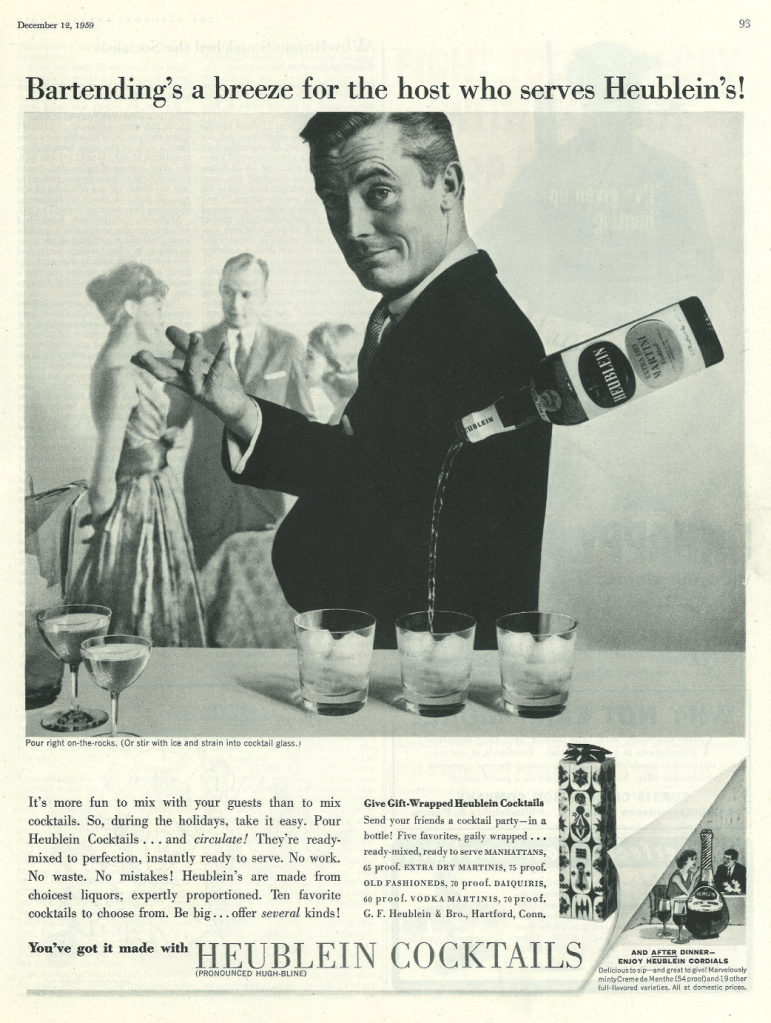
My, oh my! How cool is this ad? It hits the pulse of the times right on the head, and shouts, “Goodbye 1959, Hello 1960!” From the timeless cocktail glasses, to the exquisitely dressed people mixing it up in the background. The gentleman who is the “bartender” looks like he could have tried out for the part of James Bond, he’s so suave.
This ad reminds me of my grandparents’ household bar. They had a basement bar complete with alternating colored shag rug squares adorning the front. Six chrome legged bar stools, with thick marbled padded seat cushions. The kind you see in old movies. It fashioned a sturdy, yet fashionable Formica table top. It was fully stocked with bottles upon bottles of things with strange, foreign sounding names. My little 10-year old self had no clue what they could possible all be used for. That bar was a fixture of atomic cool. A built in masterpiece of mid-century Americana that spoke volumes.
My grandparents were not raging drunks, but they were part of that generation. The generation of this ad. People drank at parties. Hosts made sure they were well stocked with choices to keep their guests happy. Was my grandparents’ house the party house? Were they unique? I don’t think so. Their best friends had nearly the exact same bar in their basement. Drinking was pretty standard in the 50s and 60s. It was just part of the culture.
Here’s another Heublein advertisement from 1963 featuring Robert Goulet:
I was absolutely amazed when I looked into the Heublein company. This was the first I heard of them, yet they were HUGE. So huge they were included in the Nifty 50. What are the Nifty 50 you ask? They were a group of 50 large-cap stocks the New York Stock Exchange deemed most stable. They helped drive the American economy to the bull market of the 70’s. They were considered very safe investments. 1
How can a company that sells pre-made mixed cocktails be so enormously profitable? So profitable that when RJ Reynolds Tobacco Company acquired Heublein in 1982, they paid a whopping 1.2 billion dollars for the company and its holdings.2. That’s 3.9 billion in today’s dollars. Billion!. My head has a hard time wrapping itself around the enormity of this company. They were such a formidable force because they were diverse. They had their fat fingers in multiple markets. They owned brands such as:
A-1 Steak Sauce (1906)
Grey Poupon (1936)
Smirnoff Vodka (1938)
Hamm’s Brewery (1965 sold again in 1973)
Kentucky Fried Chicken (1971)
Hart’s Bakeries (1972)
They held distribution rights for:
Irish Mist Liqueur
Harvey’s Bristol Cream
Don Q Rum
Jose Cuervo
Black & White
Bell’s Whiskey
Lancer’s Wines
Guinness Stout
Bass Ale
Perrier Mineral Water
Rose’s Lime Juice
It is staggering. No wonder they were part of the 50 most desirable stocks of the 60s and 70s.
Back to our ad above. It is pure class. That suit, the tie, the dress the woman on the left is wearing. You can almost feel the silkiness of his tie and her sash. Let’s not forget to notice the stylish updo she is sporting. The flourish of his hand, as if he is part bartender, part magician. I’m not sure how they suspended the bottle to show it during mid pour, but it’s pretty darn cool and decidedly on-point.
Last, but not least, check out the wrapping paper on the gift. Can I get a roll? It’s out of this world!
I long for the times of this ad. Not so much for the alcohol and what’s in the bottle, but what the ad is selling. Time. No need to spend time mixing drinks, when you can buy Heublein pre-made cocktails. You can have more time to spend with your friends and guests. For all the conveniences we have in 2024, it seems we have less and less time to entertain and just be with one another. Life moves too fast.
I urge you to unplug, by throwing or attending a party this season. Whatever your season is make the most of it. Take time to be with your friends, neighbors and loved ones. It doesn’t have to be a big gathering. It doesn’t have to break the bank. But take time to sit around drinking your drink of choice (no alcohol necessary) and reconnect with our friends, family and neighbors.
Here’s to the holidays! Let’s truly enjoy every minute we can.
“Just Pour over Ice – Who Knew? – Connecticut History | a CTHumanities Project.” Connecticut History | a CTHumanities Project – Stories about the People, Traditions, Innovations, and Events That Make up Connecticut’s Rich History., 5 Dec. 2020, connecticuthistory.org/just-pour-over-ice-who-knew/. Accessed 21 Nov. 2024. ↩︎
Langston Hughes – From his One Way Ticket Collection – 1949s Alfred A. Knopf (Publisher)
Democracy will not come Today, this year Nor ever Through compromise and fear.
I have as much right As the other fellow has To stand On my two feet And own the land.
I tire so of hearing people say, Let things take their course. Tomorrow is another day. I do not need my freedom when I’m dead. I cannot live on tomorrow’s bread.
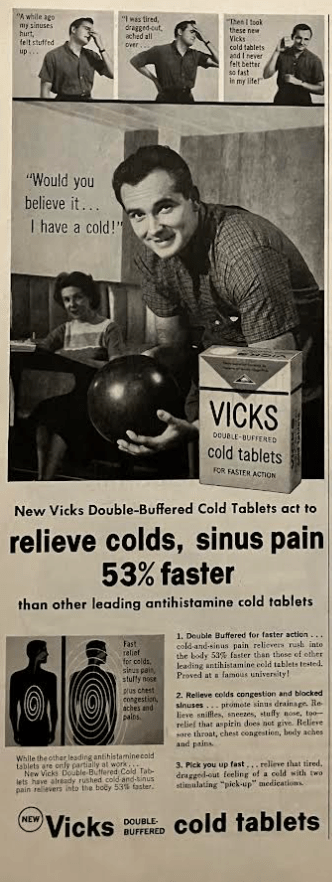
I mentioned a while back that I was going to try to find a few more evenly gendered ads. In that spirit, we have a man and his ball. Bowling ball that is.
Ads that use bowling are a bit hard to come by. You wouldn’t think so, since the Golden Age of Bowling wasn’t that long ago. During the 1960s-1970’s pro bowlers were being signed on for boku bucks. Some even rivaled contracts of NFL players.1 It was big business. The advertising executives at Vicks knew a good thing when they married cold tablets with bowling. Bowling was so huge it had stars like Dick Clark and Jayne Mansfield advertising for AMF (American Machine and Foundry), which had moved into the bowling industry after WWII.2 AMF helped to automate the game, by creating a pin setting machine as early as 1946.3 With its rise in popularity in 1959 it’s no wonder companies wanted to get in on the game. Not to mention, men get colds too. What a great way to grab a man’s attention.
A quick snapshot of Vicks. Vicks was founded back in 1894. They would go on to create a host of healthcare products. A quick rundown of their most famous products include4:
1894 – Vicks Croup & Pneumonia Salve
1911 – VapoRub
1931 – Vicks Cough Drops
1941 – Vicks Inhaler
1951 – Vick’s Cough Sryup
1958 – Vick’s Formula 44
1959 – Sinex Nasal Spray
1966 – NyQuil
1974 – DayQuil
2012 – ZzzQuil
2018 – VapoCool
That is some powerhouse of over the counter cold and flu assistance.
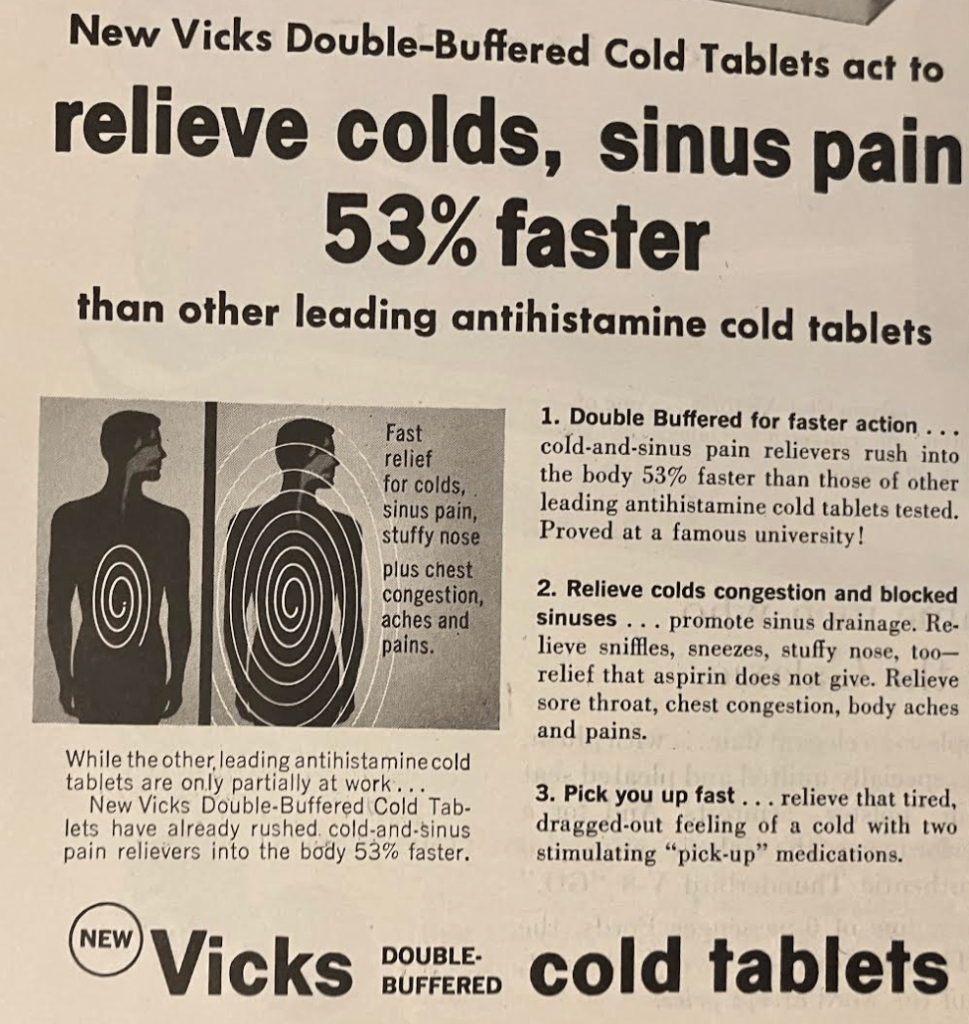
There are a few things to really love about this ad. First, the fact that they claim it helps relieve colds and sinus pain up to 53% faster. Not 50%, nor 55%, but 53%. It is so precise. They don’t present any evidence to back this 53% claim up. Misleading? Most likely, but it sounds good.
Secondly, the tablets are “double buffered” to speed up relief. What does “double buffered” mean? It piqued my interest, so I looked it up. All I could find was the use of the term “buffer” with reference to computers and the definition as it relates to medicine or chemistry in general. MedLibretexts.org defines buffering as, “buffer: A solution used to stabilize the pH (acidity) of a liquid.” Frankly, when I hear the word “buffer” I think of the generic meaning, to create a distance or protective space around something. If someone were to ask, what comes into your mind when you hear the words “medicine” and “buffer”, I would reply “Bufferin”, which is common NSAID whose base is aspirin. Either way, to tout something is “double buffered” sure does sound marvelous on paper. Its promise of fast relief ads certainty. If you know what “double buffered” means with relation to Vicks Cold Tablets, let me know in the comments, please.
Finally, this ad has a guy bowling. At first glance one might think, what’s so great about this ad? It’s just another sexist ad from the 50s. A guy and his bowling ball. How old fashioned. But, look in the background. His wife/girlfriend/date/sister plays an important part in this ad. She’s keeping score. I know it sounds like such a little thing, but I still love it. Back in 1959, they didn’t have automatic scoring. You had to score your own game on paper. I find the harmony of this ad, very refreshing. Just two people out having a good time. Celebrating the power of Vicks to make you feel stronger, faster. What fun!
Oh, and the last line, “Pick you up fast…relieve that tied, dragged-out feeling of a cold with two stimulating “pick-up” medications.” is cute. Not only will you pick yourself up fast using this medicine, but you can “pick-up” those spare pins, once you are feeling better with Vicks Cold Tablets.
Fea, John, and John Fea. “The Golden Age of Bowling.” Current, 26 Mar. 2014, currentpub.com/2014/03/26/the-golden-age-of-bowling/. Accessed 31 Oct. 2024. ↩︎
“1959 Archives – International Bowling Museum & Hall of Fame.” International Bowling Museum & Hall of Fame, 2023, http://www.bowlingheritage.com/tag/1959/. Accessed 31 Oct. 2024. ↩︎
Center, Smithsonian Lemelson. “Lemelson Center for the Study of Invention and Innovation.” Lemelson Center for the Study of Invention and Innovation, invention.si.edu. ↩︎
16,000,000 military personnel were deployed during the span of WWII.1
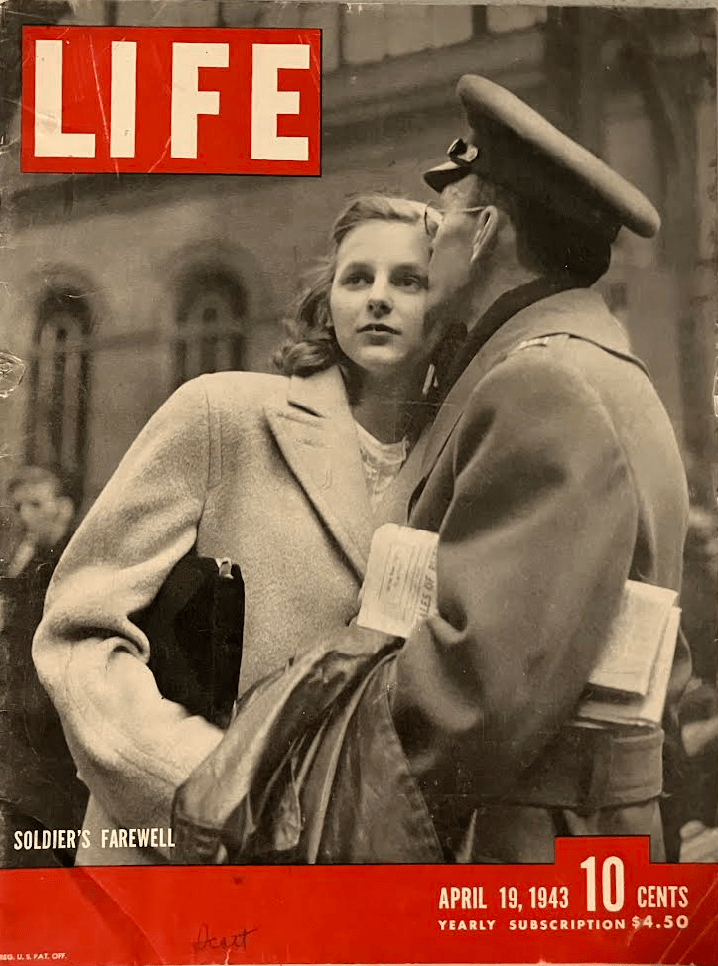
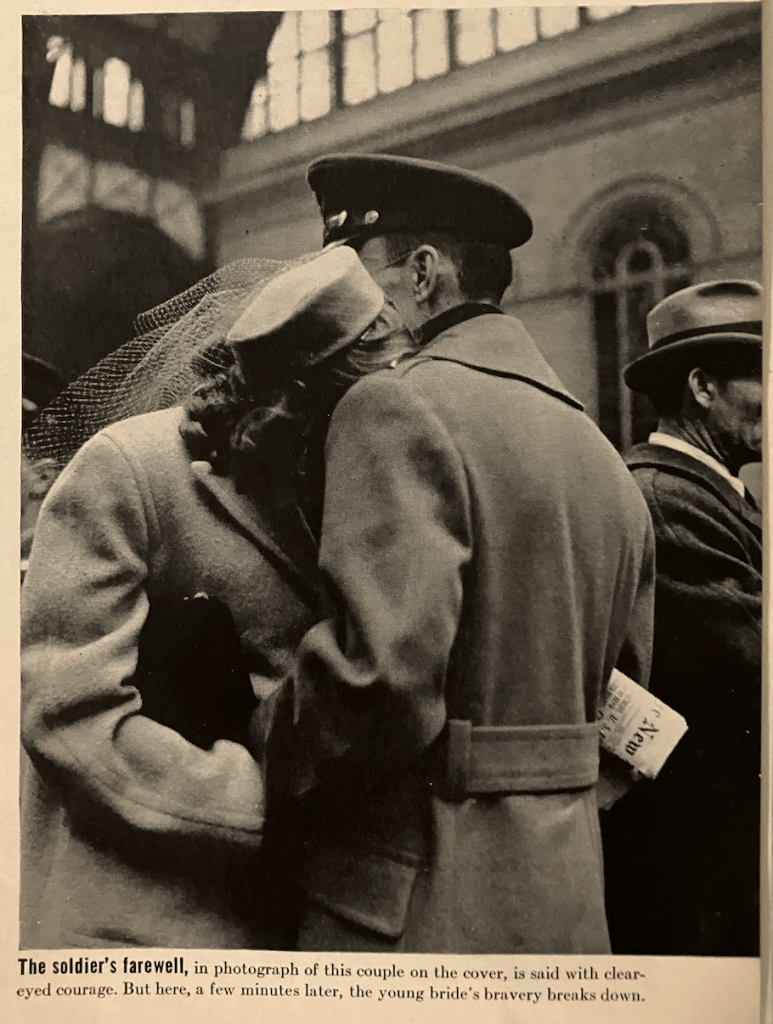
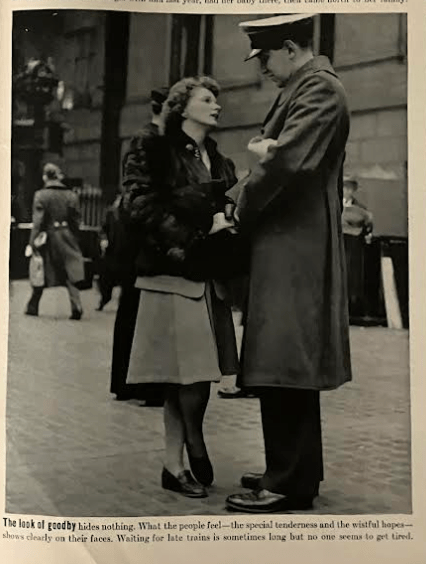
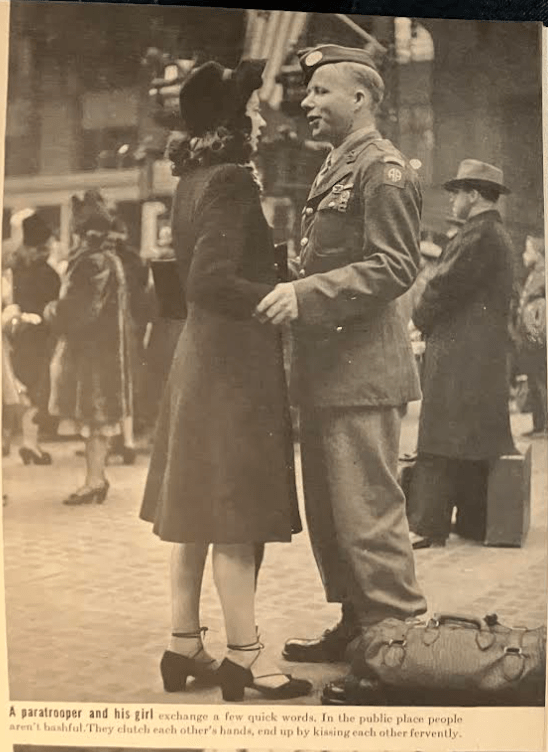
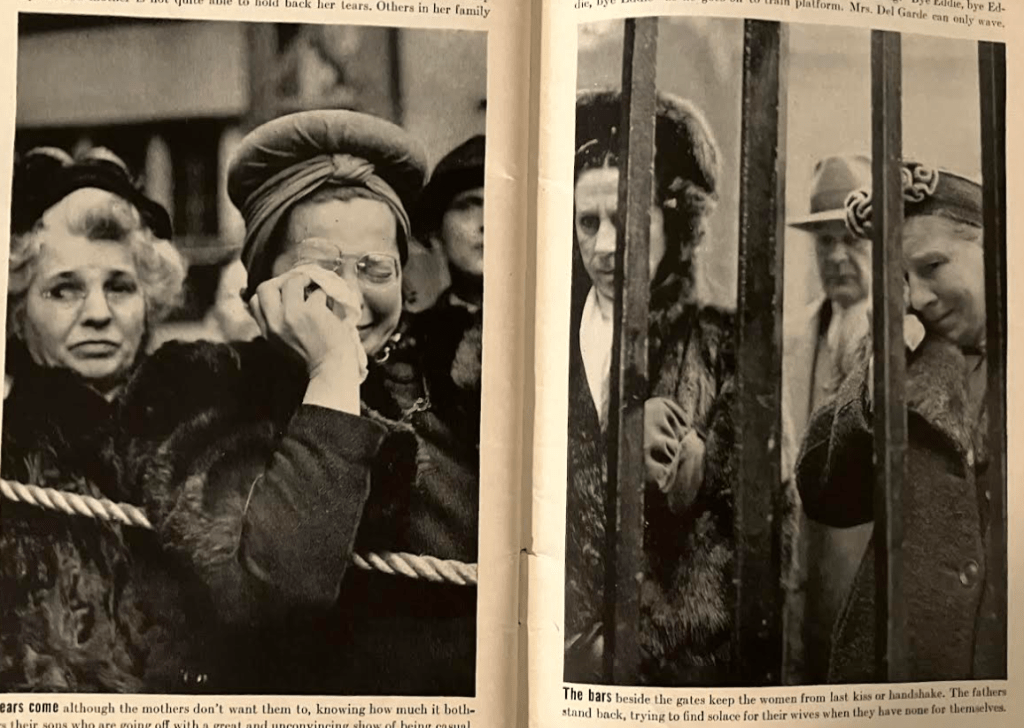
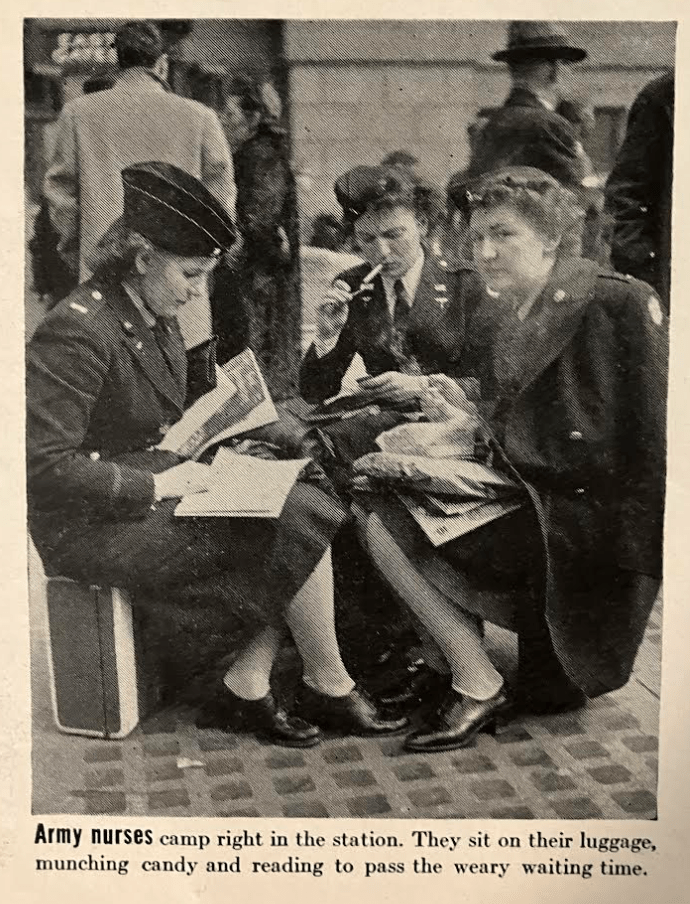
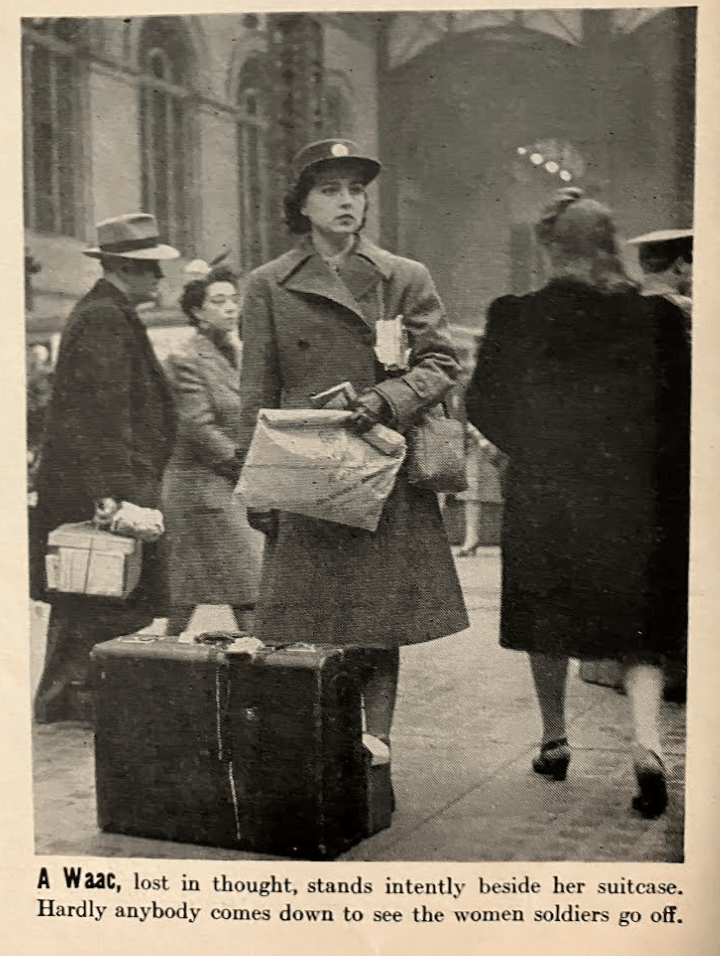
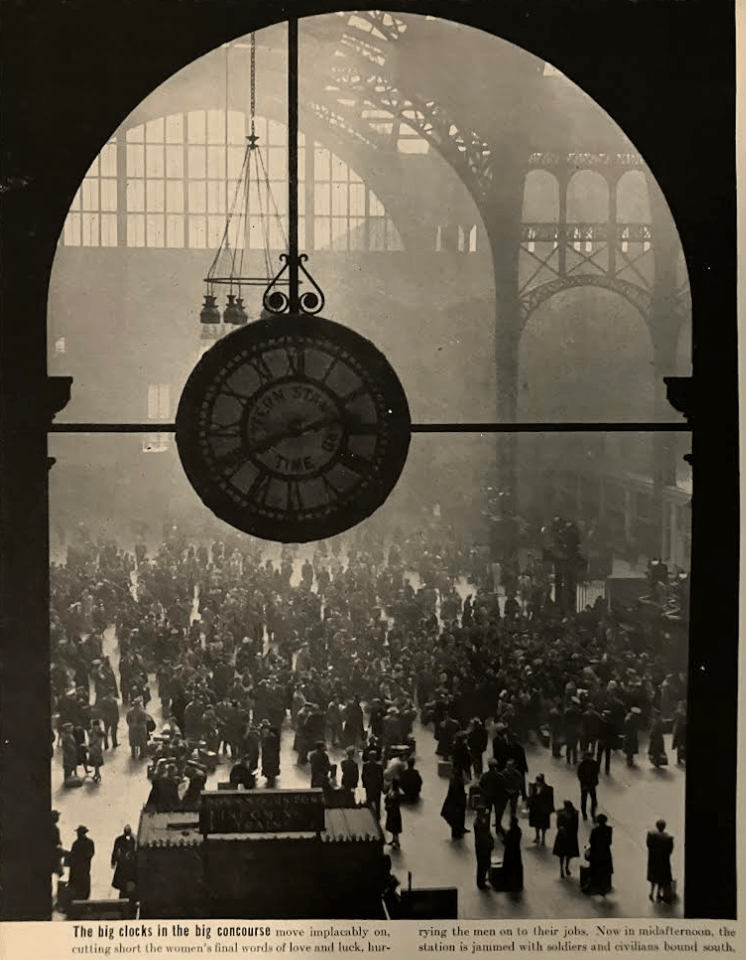
LIFE Magazine excelled at capturing candid photographs. There was a phenomenal staff photographer on their payroll. His name was Alfred Eisenstaedt. You can learn more about Alfred’s life here. He was based out of LIFE’s offices in NYC. His most famous photograph might be the VJ Day kiss in Times Square. Photographs he took during the WWII years were often weighty and important. He wasn’t one to shy away from the gritty side of life.
For a quick coffee break, I’d like to share some lesser known photographs he took. They were featured in LIFE Magazine’s April 19, 1943 issue. While this coffee break may not be uplifting, I feel these photographs are important illustrations, encapsulating the daily reality for thousands upon thousands of US citizens. Consider the time these photos were distributed. The United States had been to war for two solid years, with no end in sight.
The pictures speak for themselves. With each one, I wonder what happened to these people. The ones anxiously waiting to board and go off to war. A war they might have already seen, but most likely not. This very well could have been their first deployment. Did any of them really know what they were heading off to? How could they? What of the ones they left behind? These pictures sadden me.
The new bride from the cover photo2. Will she ever see her groom again?
The new mother, wondering if her baby will ever really know its father? Will he be coming home to see the baby grown up?
Loved ones nervous as to what the future holds.
Tears people can’t contain. Emotions running so high.
Nurses enlisting to do what they feel is the right thing.
This one hits me in the gut. The caption is so depressing.
This overhead shot Eisenstaedt took shows the scene from a bird’s eye view.
And this was just one day, out of 1,365 days that the US was at war. Just one day at one station in the country. Even though the numbers being deployed fluctuated from day to day, the scene was the same. Nervousness, sadness, weariness, loneliness, and headache settled in like a fog.
I simply cannot even imagine what this generation went through.
Gnam, Carl. “U.S. Involvement in WWII: How (and How Much) the Military Grew.” Warfare History Network, 26 June 2017, warfarehistorynetwork.com/us-involvement-in-wwii-how-the-military-grew/. ↩︎
The picture is of Lieutenant John Hancock Spear and his wife Ester. Page 20 of this issue of LIFE says they were married for four days before he had to go off to war. ↩︎









 Tidbits and Timemachines