

Vintage Advertisement of the Week – August 14, 2024
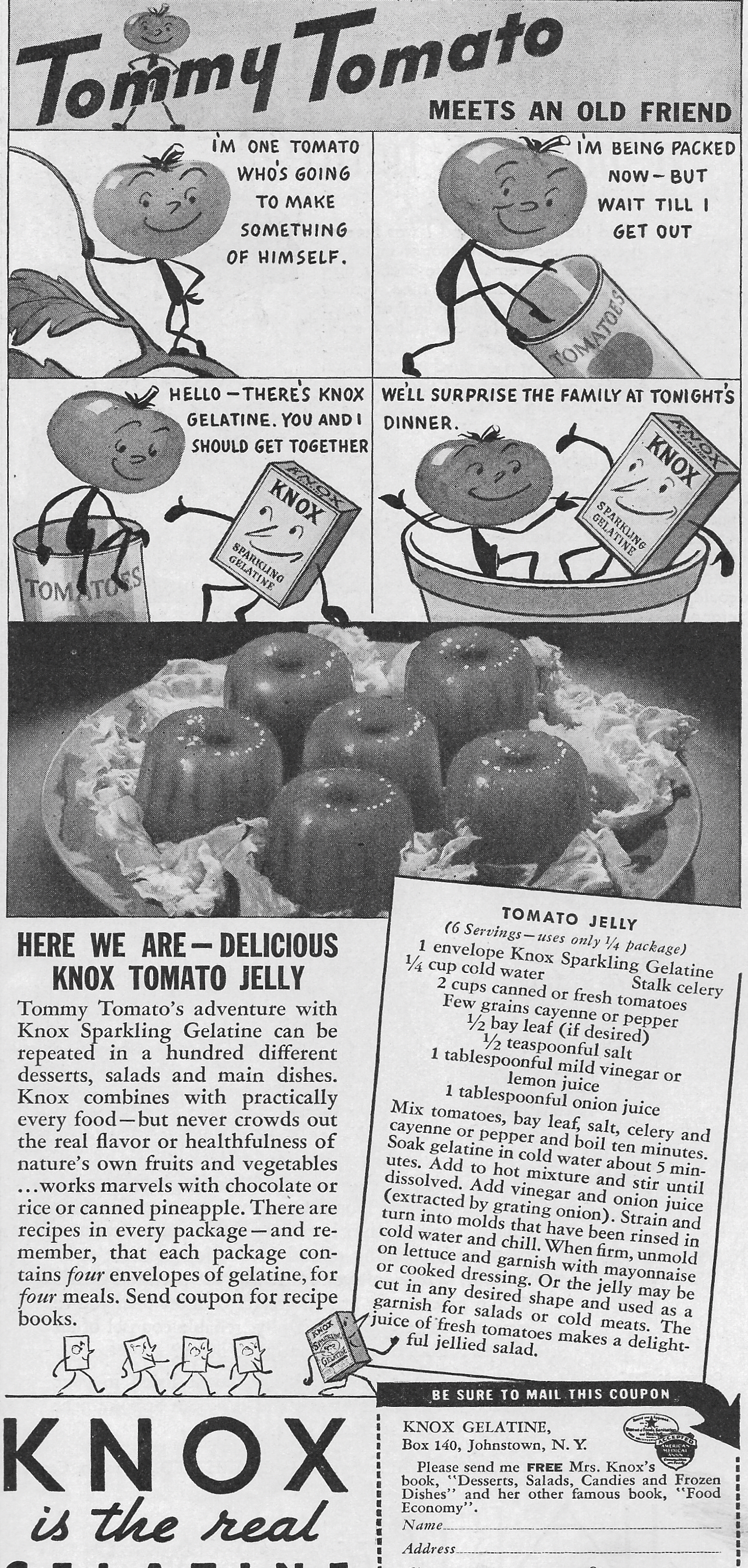
By far not the grossest thing I’ve seen in the world of the frugal 1930’s, but still looks quite unappetizing to me. Gelatin dishes from the 1910’s to the 1970’s were a bizarre island unto themselves. I could spend years discussing American food advertisers’ obsession with pushing these odd cost savings concoctions on the consumer. In my book, these tomato gelatin rings get a 5/10 on the gastronomically noxious scale. Noxious – Knox, get it? 5/10, that high of a rating you say? Oh, it gets far worse.
A brief history of gelatin – This particular recipe falls under both gelatin camps; what the average American thinks of when they hear “Jell-O” and aspic. Even though Jell-O should be fully accredited to the brand name as it is a trademarked entity, it was so widely popular that when one hears the name mentioned a person can’t help but conjure up visions of the jiggly, brightly colored, fruity gelatin. Knox gelatin can be made into a fruity dessert, by mixing fruit juice or fruit with it. It can be the base for most anything wiggly, derived from things we would rather not think about. Aspic on the other is a whole different bag of tricks. Aspic has its roots in Europe. Nearly every country in Europe has a version of aspic. Essentially, it is meat broth turned into gelatin. It can be a clear meat broth gelatin or it can have edible objects suspended and confined within its glassy walls. Beef, pork, chicken, seafood or vegetables can be mixed with gelatin reminiscent of a stained glass window. It is served cold. That’s how it keeps its shape. Tommy Tomato’s gelatin ring sounds infinitely better to me than meat and vegetable aspic. And, yes, I’ve tried it. It’s a 0/10 rating for pork and peas aspic from me, I’m afraid I’m just not that evolved culinarily speaking.
Merry Memory – Famous Actress Goes Postal Over Lack of Aspic – During the first half of the 20th century, wealthy families would order special versions of aspic, that could often be molded into statuesque “art” for show. These were often not even deemed edible, but served as more centerpieces. Billie Burke delivers a famous speech from “Dinner at Eight” that mentions aspic.1. Just try not to conjure up Glinda the Witch of the North if you can. It’s so hard to separate that gay, lilting voice from her iconic role. I do love Billie Burke in “Dinner at Eight”. It’s a great film and has a wonderful all around cast (including both Lionel and John Barrymore).
Now back to America’s obsession with gelatin…
For our argument, the marriage of Tommy the Tomato and Knox Gelatin could fall into either the sweet side of gelatin, or the savory aspic camp. It is really up to how you classify tomatoes. It’s the age old debate, is a tomato a fruit or a vegetable?
Condensed History of Knox Gelatin – One more thing, you can see that the reader of this Good Housekeeping magazine can inquire for more recipes by writing to Mrs. Knox at P.O. Box 140, Johnstown, NY. There really was a Mrs. Knox, her name was Rose Knox. She started the Knox Gelatine Company with her husband Charles back in 1890. When Charles died unexpectedly in 1908, she took the company over. Unlike Mrs. Hannon of the Hannon Chocolate Company, she had a head for business. She made the shrewd business move to target women with their product, as she knew women did the grocery shopping. She was a progressive woman. She insisted all workers were valuable and they come to work and walk through the front door (before then some workers were only permitted to enter and exit through the back door). Furthermore, In 1913, she instituted the five-day work week, gave two weeks of paid vacation for all, as well as offered sick leave. Quite unheard of for that time.2
For you doubter’s about just how gross gelatin combinations of the 20th century evolved, tune in for more strange gems of our great recipe book of Americana in the weeks and months to come.

 Tidbits and Timemachines