
As we know, this novel is highly autobiographical. So much so, that it was first published under the pseudonym, Victoria Lucas, for fear of libel suits that might arise. Plath did not disguise or distinguish her fictional characters from their real life inspirations very much at all. I’ll try to avoid making too many comparisons to the characters’ real life counterparts and treat them as fictional beings, unless absolutely necessary. Suffice it to say, Plath created many very one dimensional characters in her book. Doreen and Betsy being two such characters. Doreen was the quintessential bad girl. She was promiscuous and a partier. Betsy was naive, sweet and a country bumpkin. Doreen was exciting and magnetic. Betsy was innocent and drab. Doreen was Esther’s devil. Betsy was her angel.
Lenny Shepard and Frankie are also written with a singular agenda in mind. Lenny is the male counterpart to Doreen. Tall, masculine, attractive, and polished in a citified Western sort of way. He exudes confidence, likening himself to a local celebrity. Frankie, is written with humor, but also at times humorless. Esther paints a picture of Frankie that is comical, yet sad and pathetic. I honestly couldn’t decide if I felt bad for Esther or for Frankie. Granted, Esther didn’t pick Frankie out as her date, Lenny did. It was apparent Lenny owed Frankie one and was trying to do him a favor. A favor Esther obviously didn’t want. No one likes to be set-up on a blind date with someone they found to be off-putting. Esther saw Frankie as unattractive, too short, too ugly, annoying and terribly unfashionable. Esther was so repulsed by Frankie that she gave him a false name, Elly Higgenbottom, because she didn’t want anyone to be able to associate Esther Greenwood with the evening. By the end of chapter 1, Frankie is out of the picture and Esther is more than fine with that.
Betsy is presented to the reader as a Kansas born, corn-fed hick who is boring as sin. Esther’s antidote, where Betsy makes the TV reporter cry over her description of male and female corn, is hilarious, yet demeaning to Betsy all in one swoop. Esther knows she should be friends with Betsy and her crowd. Betsy resembled the girls she hung out with back in college, but she finds Betsy and girls like her (Hilda-Chapter 3) to be dry and lifeless. Not like Doreen, who is the only spark in her immediate circle in New York.
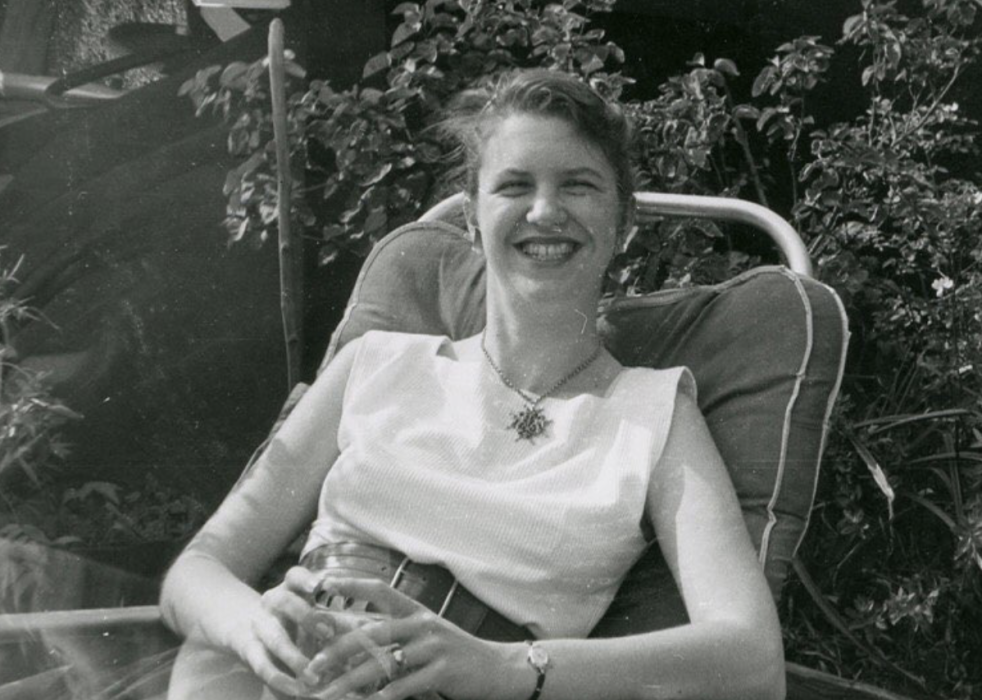
This tendency to present others around her as one dimensional to make herself seem more complex is a direct result of Plath’s own self-awareness. Plath was, without a doubt, a genius. She scored at or above 160 on an IQ test in 1944, when she was only 12 years old.1. Genius grading starts at 140. She clearly possessed a superior brain. She was a tall (5’9), pretty woman, with honey brown hair, quite attractive. Her figure was always trim, but not too thin. She herself said she could eat whatever she wanted and never gain weight. She also was athletic enough to go to a sailing camp, ride horses, and play tennis and basketball in high school. The only subjects she ever slightly struggled with were Gym, German and History. By struggle, I mean she didn’t get a solid A, but instead got a few B’s in junior high. Oh the horrors of not getting straight A’s!2
Plath was immensely hard on herself. She was a perfectionist to the extreme. So much so it affected her mental health at an early age and never really resolved during her life.
It was no wonder she might look down on others that seemed less than her. Yet, all this plays into the other stance, that Plath was a narcissist. She thought very highly of herself, and felt many around her were not as intelligent or worthy of her time. She fixated on people, propped them up on pedestals and knocked them down just as fast. Her journals and diaries are rife with examples of infatuations, boys and girls alike, but mostly boys.3
Plath was extremely secure and insecure at the same time. She was a paradox. It is no wonder, she wrote Esther to be as multilayered as she was. This notion of needing to be perfect is a theme that pops up throughout the novel, and adds to Esther’s decaying mental state. It is a theme the reader cannot escape.
- Leha. “Sylvia Plath and How Mental Illness Is Romanticized.” THE LITERARY AFFAIR, 31 Mar. 2021, theliteraryaffair.com/2021/03/31/sylvia-plath-and-how-mental-illness-is-romanticized/.
↩︎ - Wilson, Andrew. Mad Girl’s Love Song : Sylvia Plath and Life before Ted. London, Simon & Schuster, 2013.
↩︎ - (Wilson) ↩︎

 Tidbits and Timemachines